
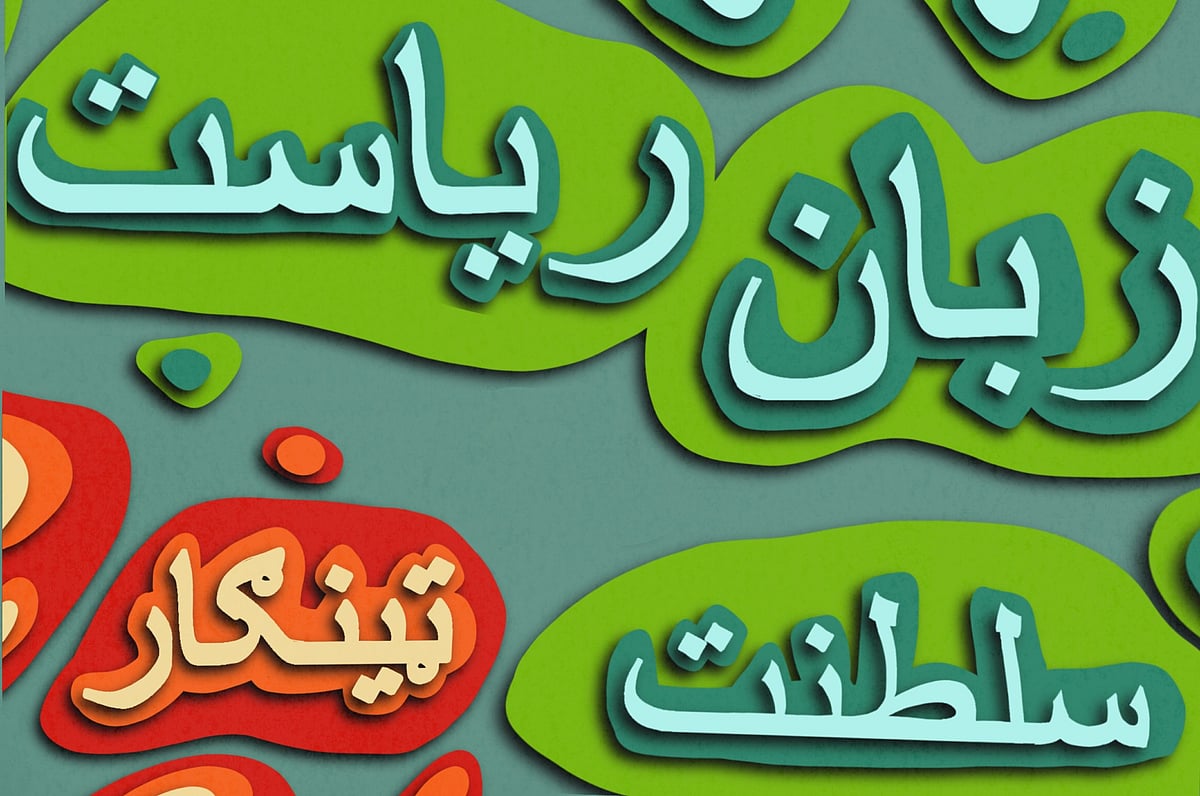
A language doesn't belong to its people. But perhaps people belong to a language. I belong to Urdu as much as I belong to Pashto or English. Language carries cultural-historical memory and, by extension, collective human wisdom. It makes us human.
But language can also be, and often is, used as a tool for oppression. In all its richness, Urdu is a language of resistance too. It has lent itself to the creation of some of the finest resistance poetry of the region, and because it is widely understood, it works for communication as well as mass organising. However, language as a tool of nation-and-state-making (and 'nation state' making) takes on a totally different role. It is ironic that while Urdu is being gradually erased across the border in India, the language has become one of the tools used to level cultural, linguistic and historical richness and diversity of Pakistani society.
This erasure extends back to the days of the British Empire, specifically to the second half of the 19th century, after the end of Company rule in India. In Self and Sovereignty, historian Ayesha Jalal uses historical records to document how the colonial administration made Urdu the official language of governance, policy-making and communication in the regions which are now Pakistan. Meanwhile, other regional languages were officially designated as vernaculars, and thus unfit for the purpose of governing. Even though these languages carry centuries of literature and heritage, Punjabi, Sindhi, Pashto, Balochi and Seraiki and all the other languages spoken by the communities in this region were written off. This policy of erasure made sense for the colonial administration, as its purpose was not to foster a nation of people with disparate ethno-linguistic and cultural identities, but to discipline them in order to extract more resources for the British Empire.
The regional languages in territories that are now part of Pakistan continue to be ignored by the postcolonial state, and the violence of this erasure is even more intimate post-Independence. The people who came to rule Pakistan and define its national identity were unable to transcend the colonial logic of state-making. Soon after the creation of the new state, Urdu was imposed on the majority of the country, including in the east which was overwhelmingly Bangla-speaking. The supremacy of Urdu has since been asserted not only to erase other languages but also other narratives and traditions which are not deemed part of the state's literary and cultural projects. One example of this is how cultural stereotypes about Pashtuns have been produced and perpetuated.