
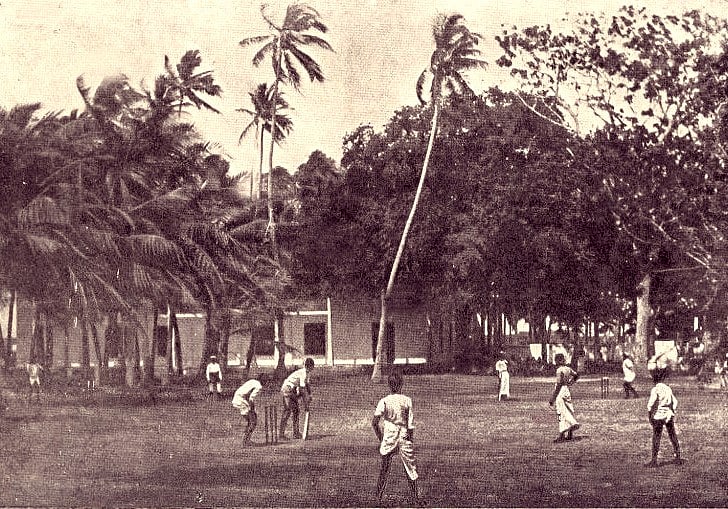
Modernity took firm root in Ceylon under the imperial aegis of Britain. British rule ushered a considerable transformation in the political economy of the island, a revolution in the communication system, the administrative unification of the country and the emergence of new (capitalist) class forces. English became the administrative language, leading to the development of an indigenous socio-political elite – referred to locally as the "middle class" – whose mode of domination included a facility in both the English language and lifestyle.
During that process, the ethnic diversity of the island was compounded. Apart from the Tamils, Sinhalese and Tamil-speaking Moors of yesteryear, one witnessed the influx of people identified as Indian Tamils, who worked on the plantations in the interior or as menial labourers in the main urban centres. The island's location also encouraged small groups of Malays (who had served in the Dutch and British regiments), as well as Bohras, Sindhis, Parsees and Colombo Chetties to join the mixed European descendents described as 'Burghers' in the polyglot towns of the southwestern quarter of the island, most notably in Colombo. By the 1880s, Colombo was the island's hegemonic centre, looming over the rest of the country with its political and economic clout, as well as its symbolic primacy. It was this primacy in Colombo's status that was to prove central in the evolution of another overwhelming hegemony in Ceylon: that of cricket over all other sports in the country.
It was through Colombo, too, that the intellectual currents known as 'liberalism' and 'nationalism' first entered public consciousness. A small coterie of young Burgher men, educated in English at the Colombo Academy, comprised the forerunners of Ceylonese nationalism when, in 1850, they launched the periodical Young Ceylon. This new way of thinking was sustained by the emerging multi-ethnic, indigenous middle class over the course of the following century. The first momentous challenge to white superiority occurred, prophetically, on the cricket field, when the best Ceylonese XI took on the best local Europeans in June of 1887, in a match they lost. This began an annual Europeans-versus-Ceylonese series that lasted until 1933 – a series in which, by the 1910s, the Ceylonese were usually the victors.
Cricket was also a medium for the encroachment of other Westernised ways of life, particularly that institution known as the club. Thus, cricket's anti-colonial dimensions were qualified by strands of Anglophilia and a distancing of its bearers from the hoi-polloi. Indeed, running parallel with Ceylonese nationalism, one saw indigenous resistances of a more marked anti-Western character. There were two threads intertwining here: the hostile Hindu and Buddhist reactions to Christian proselytising on the one hand, and hostility towards the English language and Westernised lifestyles (and the associated assumptions of superiority) on the other. Among some Sinhalese, this resistance was quite virulent, and one can point to a cohesive Sinhalese nationalism from the 1860s onwards.