
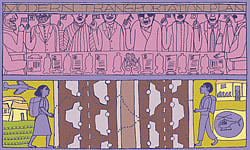
Reconnecting Southasia to itself and the world", the Indian Foreign Secretary Shiv Shankar Menon often reminds us, is an important long-term political objective for New Delhi as a member of SAARC. But given the Subcontinent's reputation as the least-integrated region in the world, Menon's goal for India seems ambitious. As the region limps towards the implementation of a free-trade agreement, it has also begun to explore prospects for trans-border and trans-regional highways, rail lines and petroleum pipelines.
Yet the inability to make rapid progress on either free trade or deepening connectivity together points to the huge gulf between the proclaimed objectives on regionalism and the capacity of India and its surrounding neighbours to realise them. Part of the problem lies in the rather innocuous-sounding first word in Menon's phrase – reconnecting. Paradoxically, Southasia finds it hard to integrate and connect precisely because it was, until the middle of the last century, a single economic and cultural space. The Great Partition did not merely break up the political unity of the Subcontinent; it also divided its markets, laid waste its significant internal connectivities, and made it difficult for people and goods to move across the new borders. Connecting and integrating are clearly easier than re-connecting and re-integrating.
The inward-looking economic policies and prickly nationalism all across the Subcontinent made the cross-frontier contact even more rigid as time went on. Meanwhile, the tensions between India and China after the late 1950s managed to shut down the centuries-old trade and commerce across the Himalayan rimland. Reconnecting Southasia, thus, is surely an ambitious objective, for it involves overcoming the bitter legacies of the Partition, the India-China rivalry, and an unfortunate mindset about borders that has emerged in Southasia, and especially in India.
As pointed out by Shyam Saran, Menon's predecessor as foreign secretary, "India must start looking at national boundaries not as impenetrable walls which somehow protect us from the outside world, but as 'connectors', bringing India closer to its neighbours." He adds: "Another mindset change is to stop looking at our border areas as being on the periphery or serving as 'buffer zones' preventing ingress into the heartland." It is evident that Saran and Menon, two of India's more imaginative senior diplomats, are trying to change the systemic thinking in New Delhi about its frontiers. And indeed, they appear to have had some success in generating support at the highest political levels.