
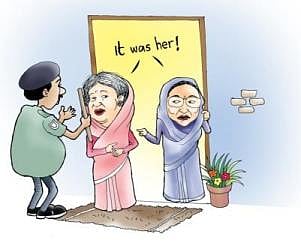
Bangladesh's political orchestra is reaching a crescendo, at least for this passage. What comes next may be a long, deafening silence. As the two political dynasties were made to exit the country, the remonstrations of the two heads were heard far and wide. The military-backed interim government's tackling of its envisioned 'minus two' rescue plan for the polity has been neither smooth nor discreet. Despite the noises made out of entrenched political camps, however, it has become clear that there is no turning back for Bangladesh. The tables have been turned.
In January, when the military-backed regime took power with an initial 'emergency' mandate of 120 days (which will end on 10 May), there was no timeframe in place for elections. Chief Adviser Fakhruddin Ahmed and his military backers provided such a timeline – elections by the end of 2008 – almost as a gift on the eve of the Bengali New Year. But even as the chief adviser was delivering his address to the nation on 13 April, rumours were already rife of plans to exile Begum Khaleda Zia, chair of the Bangladesh Nationalist Party (BNP). Talk of Sheikh Hasina Wajed, president of the Awami League, being barred from entering the country was also being heard. For most of April, Dhaka was a city of rumours.
With all forms of political activity banned, there was very little opposition to the action against the heads of the two main parties when it finally took place. With the anti-corruption dragnet picking up politicians from across the political divide, no one dared to speak out. There had been pressure on Khaleda Zia to leave the country since her son Tarique Rahman's 7 March arrest. But it was not until her second son, Arafat Rahman, was picked up in a midnight raid at her residence that, on 17 April, she agreed to depart for Saudi Arabia with her immediate family. One down, another to go, it seemed.
The wait was not long. With no foreseeable obstacle to the plan, on 18 April a government press notice stated that Sheikh Hasina had become a "national-security risk", and was therefore barred from returning to the country from a trip to the US. A day after Hasina had declared the interim government "unconstitutional" in an interview, the government publicised the corruption charges against her. Suddenly, the accusation of political murder was added – a charge that carried with it an arrest warrant. With the travel ban in place, Hasina made an attempt to return to Bangladesh, but was denied entry to an airplane in London on 22 April, the morning the warrant was issued.