
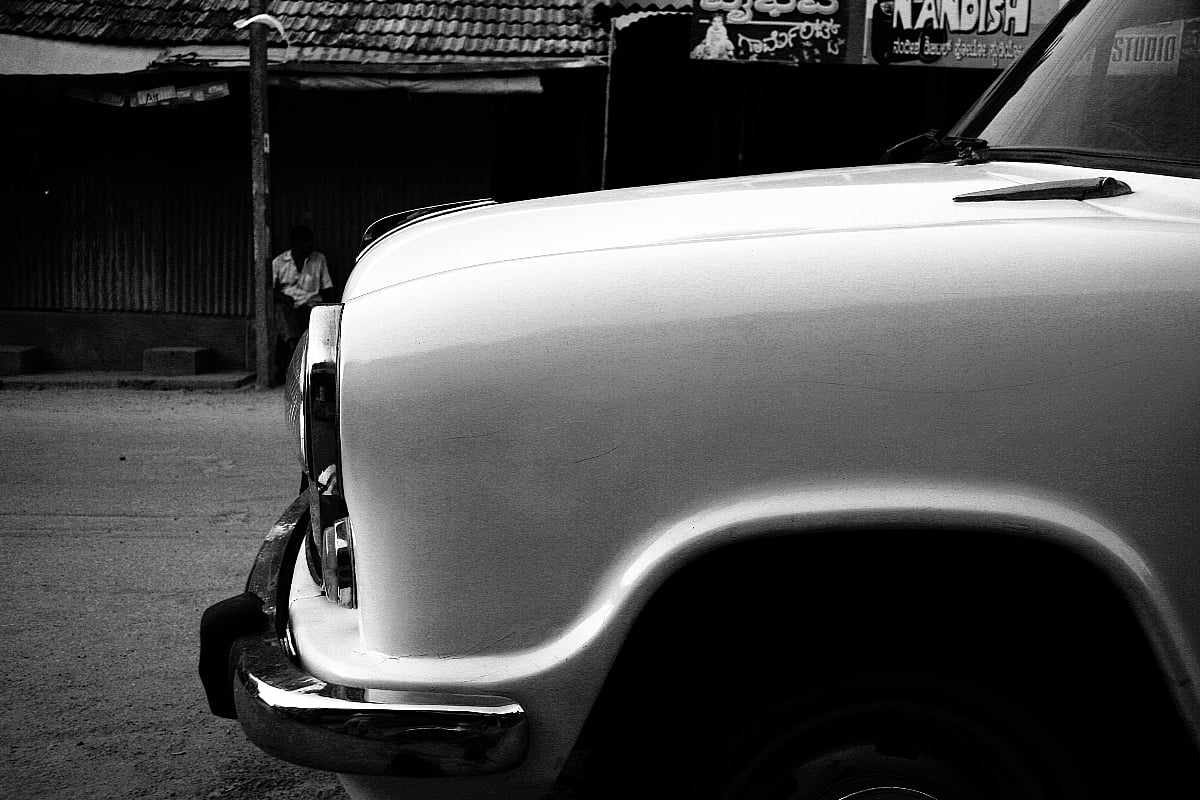
A mention of 'the Ambassador' immediately conjures up images of a corpulent car with more than ample leg space and the capacity to carry, at a crush, the largest of Indian families. For the BM (Before Maruti) generation and before the advent of more ritzy cars in the Indian market, the good old 'Amby' was the country's workhorse. People either learnt to drive it or were driven in it. They had no choice.
It was (and still is) the car of the President of India, the vehicle for the highest and the powerful in the country even though the foreign dignitaries and the new economic elites may prefer the Mercedes or Citroen. In all their official functions, the motorcade following the president or the prime minister is made up of the national pride, the Ambassador. The preference of fastidious bureaucrats and police officers in the capital Delhi, Calcutta or Chennai are white Ambys, while army officers zoom around in Ambys that are black and green in colour.
Over four decades, the sturdy Ambassador's portly outline has become an integral part of the Indian road-scape. While there are cities which prefer some other makes —for example Mumbai seems to prefer Fiats (Padminis) just as Calcutta loves the Amby —the Ambassador is still the country's automobile king. While the Morris Oxford, after which the Ambassador was fashioned, has long been of interest only to automobile collectors, the Ambassador has refused to have its epitaph written. While other Third World countries caught in the economic time warp —such as Cuba, Cambodia or Vietnam — continue to tinker with 1950s sedans and keep them on the roads, only in India is a relic of the first half of the 20th century still produced.
BM and AM
It was the entrepreneurial spirit of GD Birla that saw his flagship company Hindustan Motors (HM) registered in Calcutta after Independence, in 1950. Amby started its pedigreed life as the "Landmaster" and it was only after 12 years that it got its legendary name. Its reputation grew and so did its price. Over the years, the body underwent cosmetic changes but gasoline continued to provide the juice till the 1980s, when the diesel engine arrived.
In the car's heyday, which was in the early 1980s, the Uttarpara factory near Calcutta was manufacturing 30,000 of it a year. Dealers in Calcutta recall that the waiting period to buy an Amby was anything between five to seven years. There would be under-the-table deals to expedite delivery of an Amby for the daughter's dowry. It usually arrived after the baby was born, though. Others say that way back in the 1970s, they were willing to pay the princely sum of INR 5000 over the original price even for a secondhand Amby. An uncle recalled how his life's ambition was to have his engineer son hired as a mechanic in Birla Babu's factory. The patriarch seemed never to disappoint a jobseeker, and his benevolence, call it feudal, caused the workforce to swell to 14,000.