
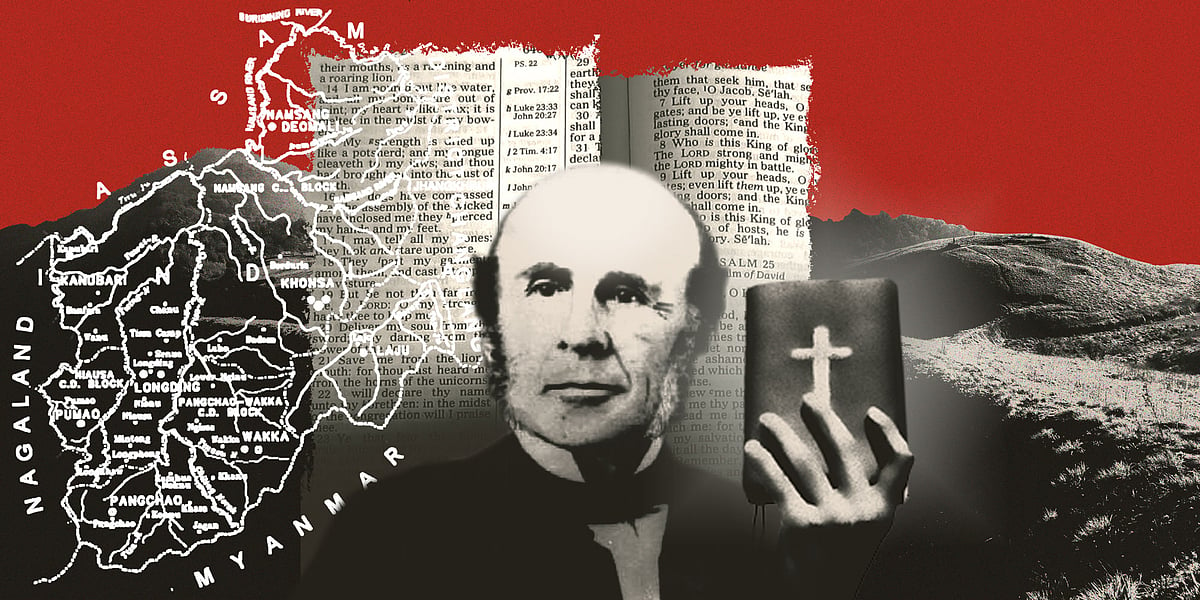
In 1840, Reverend Miles Bronson wrote to the Political Agent and Commissioner of Assam Francis Jenkins about the difficulties he was facing in converting Nagas to Christianity, and about a year later, his decision to withdraw from the Naga highlands, then still largely terra incognita to the British. A century after, Christian convictions formed the heart of the emergent struggle for Naga independence. Today, the state of Nagaland is popularly dubbed a 'Christian state'. Amidst the escalating influence of Hindutva in India, Naga politicians and pastors remind their electorate to protect their Christian faith, culture and identity at any cost.
The Nocte Naga village of Namsang (in modern day Arunachal Pradesh) where Reverend Bronson set up the first Naga mission station in 1839 was the cradle of Naga Christianity. Strangely, however, the story of Reverend Bronson and his mission field is largely forgotten today, perhaps because it was so short-lived (less than a year) or because it did not yield any converts. Instead it is Reverend Edward Winter Clark and his wife Mary who are often foregrounded. On 22 November, 2013, a statue of Rev. Edward Winter Clark was unveiled in Akhoya village, in Nagaland, casting him as 'the first missionary to the Naga soil.' This description, however, is not substantiated by historical fact.
In its initial years, the British East India Company prohibited evangelising amongst the colonies. They feared it could hurt local sentiments and consequently hurt British commerce. Their stance changed with the Charter Act of 1813, which allowed missionary activities, and was enacted in response to pressure from the British public.
In 1792, prior to the Charter Act, the British missionaries William Carey and John Thomas had arrived in Calcutta (now Kolkata) and had begun their 'groundwork' while camouflaging themselves as indigo makers. Not permitted to evangelise in public, they set up a base in Serampore, which at the time fell under the Danish flag. They stayed on in Serampore after the new legislation was passed, which formally opened up the Indian mission field.