
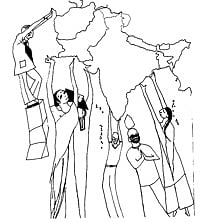
Just how 'real' is this region we call Southasia? On the one hand, there are those who suggest that 'Southasia' is a geopolitical invention imagined and brought into being only by intellectuals, journalists and academics, through reading and writing about it. On the other hand, others suggest that this is not some ephemeral idea, but rather a tangible thing that exists in the physical world. The eventual understanding of this question has important ramifications for the future possibilities of coexistence and interaction amongst the region's 1.5 billion people.
A key to conducting this line of inquiry is Benedict Anderson's seminal work from 1983, Imagined Communities: Reflections on the origin and spread of nationalism. Of Anderson's many insights, a particularly astute one relates to the role that diverse groups of elites have played in the formation of modern nations. Anderson tells us that, during the late 1800s, when the first wave of nationalist agitation made its appearance in the American colonies, the 'creole' elite (native born but of European origin) played a leading role in the movement for national independence. In India, a similarly diverse Westernised elite took the lead in forging national consciousness, even though we now recognise that non-elite groups also took their own initiatives in imagining the shape and character of India as a 'nation'.
By definition, a creole population is made up of peoples from multiple places and races. Its desire to inhabit a sovereign national territory is fuelled precisely by its shared memory of previous displacement, on the basis of race, religion or territoriality. But what bearing does this fact of elite agency behind nationalist mobilisation have on the imagined community of Southasia? It turns out that the imagining of the entity of Southasia has behind it three distinct groups: the United States policy elite, the Southasian political elite, and the region's intellectuals, both homegrown and diasporic.
Most readers will be aware of the US-centric genealogy of Southasia as a recently imagined geography. For example how, during the Cold War, the US government's foreign-policy leaders identified the region as an entity, giving it a new habitation and a name. Their "planetary gaze", as some have dubbed it, sought to present the entire region as an object of suspicion and desire, to be managed in relation to other comparable geopolitical entities. This geopolitically useful view of Southasia as a crucial node in the map of US global power, requiring minute study and observation, is a familiar claim in 'area studies' scholarship. Over the years, Southasians of diverse backgrounds have sought to make the concept their own by means of a syncretic process sometimes called 'transculturation' or hybridity.