
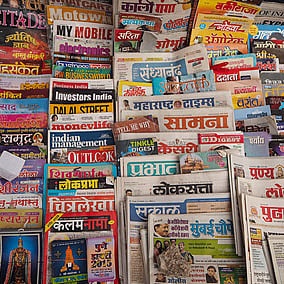
Of all the myths about Indian media, probably the most pervasive is the one that concerns a supposed golden era of Indian journalism. You can read or hear the learned citizenry (journalists included) across political beliefs reminiscing about a time when the coverage and presentation of news was honest and objective; and how it's all been irretrievably lost! According to this narrative, the Indian media is now besieged by a dangerous mix of shadowy capitalists and politicians leading to paid news, mediatisation of politics, and generally a gaudy sensationalism that passes every day in print and TV channels as news.
To be sure, the fears are genuine: with a growing concentration of ownership in the country's already oligopolistic media markets, information risks being treated as if it is a private good, available only to the high and mighty. What must not be forgotten, though, is that the Indian media owes its growth to an advertisement-driven capitalist model: both Ramakrishna Dalmia, who acquired the Times of India in 1945 from its European owners, and Ramnath Goenka, who started the Indian Express in the 1930s, were primarily Marwari entrepreneurs who detected a growing hunger for information among people who were potential consumers as well as newspaper readers. Similarly, as Robin Jeffrey's seminal book India's Newspaper Revolution (2000) showed, towards the end of the Emergency, political awareness and a quest for information among the ordinary citizen, coupled with improved technology and a search for new consumers by advertisers, helped Indian-language newspapers, almost all of a sudden, take off.
The crucial difference is that in the early decades the businessmen-turned-media barons feared governments, and policies protected the government's interests; in 2014, however, with the government tamed, the main concern of media owners is improving revenues which are often puny compared to the size of the market. It was expected that as India's democracy matured, the advertisement-driven model would slowly give way to a subscription-driven model – as indeed is the case with some of the Western publications and channels – which would in turn increase the dependence of the media organisations on consumers, thereby enhancing the quality of news. On the contrary, in 1994, when the Times of India, India's most widely read English newspaper, adopted the policy of minimum possible cover price to rout out rival Hindustan Times, the practice was quickly followed by all other players. The spread of digital media in the last few years has, if anything, only upped the confusion about revenue models: the most recent manifestation of this is Reliance India Limited acquiring the Network 18 group, and revealing its plans to maximise the benefits from the upcoming fourth-generation (4G) high-speed data transfer business.
Often a part of the blame for the sorry state of journalism falls on the consumers. In an opinion piece for Gaon Connection – a newly launched Hindi weekly newspaper which aims to expand into the rural areas in Uttar Pradesh (UP), Bihar and Jharkhand by filling the information vacuum left by mainstream newspapers – the popular NDTV anchor Ravish Kumar urged the audience to transform themselves from passive consumers of media into active users, people who can think critically on important events of the day.