
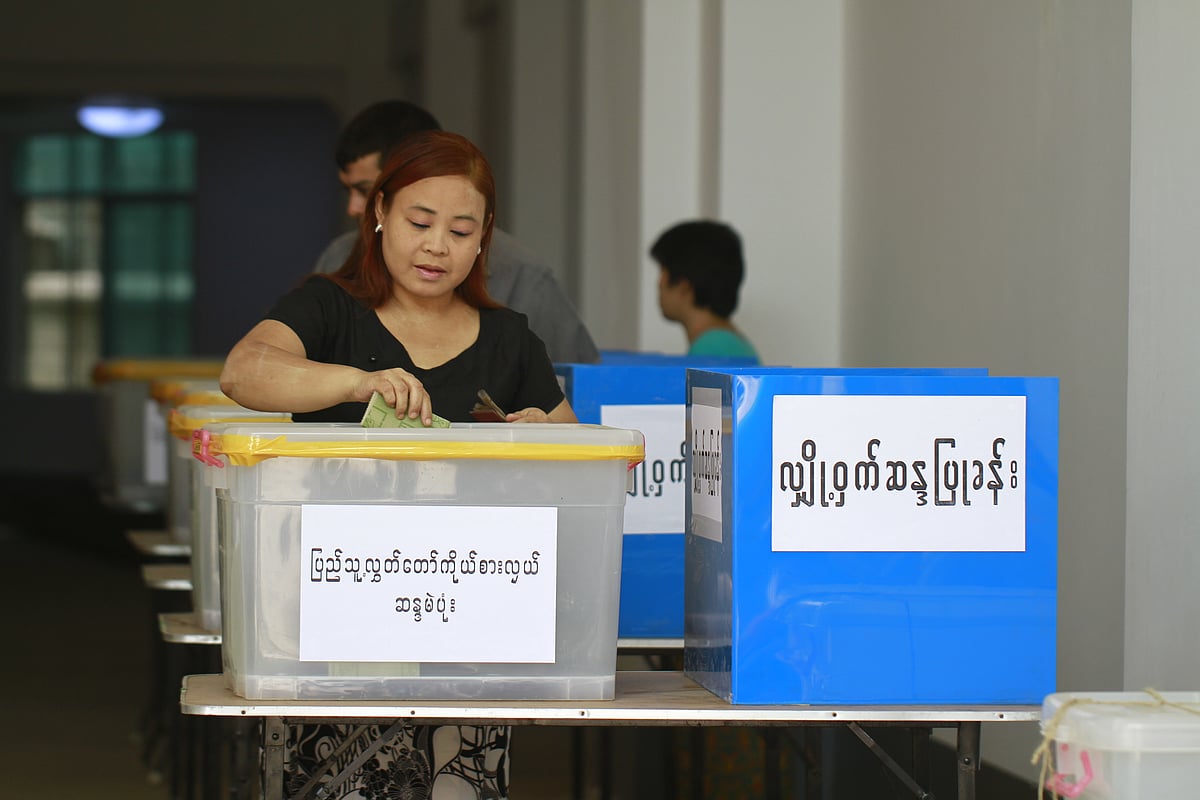
Burma's military regime has learned to speak election double-speak, framing the upcoming 'selection by the generals' as 'democratic elections'. But there are few takers among the Burmese people, other than vocal election cheerleaders and regime apologists. And it is the country's aging despot, 'Senior' General Than Shwe, who is said to be directly managing the military's attempted transition from direct rule to indirect rule with a civilian mask. The general is holding the cards close to his chest, at times leaving his subordinates and deputies in the dark while he markets his moves as the final step in the Roadmap to Democracy.
The neighbours, meanwhile, from ASEAN as well as China and India, cannot wait for the end of the 'election' episode – currently slated to take place on 7 November – so that they can deflect international criticism over their cosy ties with the only true military dictatorship in South or Southeast Asia. For their part, most global Burma experts (at the Brookings Institution, for instance, and the International Crisis Group) have been harping on the need to seize the opportunity of the purported changing of the guard in Naypyidaw to nudge the next generation of military officers towards economic reforms – which, they argue, will bring about political liberalisation. However, the living evidence of post-Maoist China stands in the way of validating such a half-baked 'development-democracy' theory.
Still, the opposition within Burma is also not completely united. Much to the dismay of Aung San Suu Kyi of the National League for Democracy (NLD) and other leading dissidents, some European Union governments (for instance, Germany) are supporting a small group of NLD renegades with no public following, who are treating the election as 'the only game in town', to borrow the pragmatic words of David Lipman, EU ambassador in Bangkok. Clearly Suu Kyi and her several thousand colleagues behind bars, as well as thousands more in exile, do not share such pragmatic resignation.
Watering the poison ivy
If the unfettered market is the raison d'être of the post-USSR world, then what is referred to as 'civil society' has become a key political instrument, policy objective and funding programme. This highly contested academic construct – manufactured in 18th-century feudal Germany – suddenly found itself in vogue, especially among policymakers, journalists and clever interns in Western capitals. In place of genuine political solidarity with the several thousand Burmese dissidents behind bars and the public at large, these Western election cheerleaders have offered both podiums and per diems for bogus 'civil society' activists who are not at all representative of the public sentiment.