
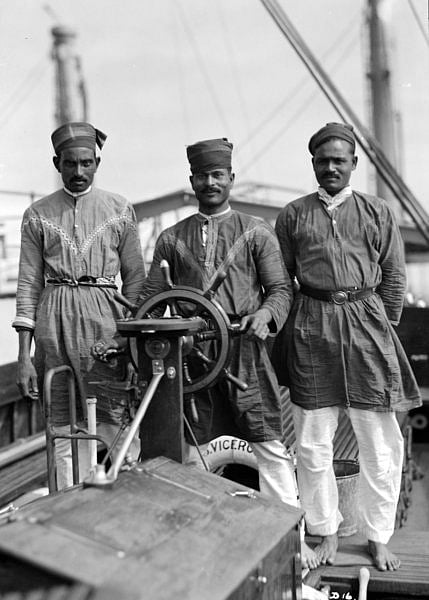
Vivek Bald's intricately researched and exquisitely rendered Bengali Harlem and the Lost Histories of South Asian America exposes at least three truths regarding the story of Indians in America today. First, relatively affluent, post-1965 'techies' have hijacked the narrative of Indian immigration to America from their scrappier, working-class and itinerant forebears; second, the voices of Sikhs and Muslims who were critical in the fight for individual and collective rights in the US in the first half of the 20th century have been sidelined; and third, current 'model minority' narratives pander to the pretences of upper-caste Indians, as well as mainstream American assumptions regarding equal opportunity. In exposing these truths, Bengali Harlem tells a superb tale of 19th-century globalisation and the role that Harlem, New Orleans, London and Chittagong played in this process, reminding us that globalisation is older and deeper than we have come to think.
In exposing these truths, Bald's work provides a necessary corrective to persistent, one-dimensional tropes regarding the Indian American experience. Indians are widely represented in the American media as highly literate, hardworking, socially-awkward, 'authentic', Hindu and conservative. This representation is often true to how the community sees itself. In a piece of pop sociology attempting to explain the relative success of different ethnic groups in America today, including Indian Americans, Amy Chua and Jed Rubenfeld cited the importance of three traits: a cultural superiority complex, insecurity and impulse control. Among the diasporic Indian middle classes, the argument has been well-received. Of course, such analysis invariably comes with an insidious comparison to African Americans and Hispanics, who presumably do not have these winning traits. (Such arguments ignore the fact that if one controls for parental accomplishment and education levels, people of Mexican origin residing in the US are more successful than people of Chinese or Indian origin.) Narratives concerning what 'makes' a model minority generally avoid the question of class and race. Thankfully, these questions are central to Bald's account.
Jumping ships
The early history of working-class Punjabi migrants to the US West Coast has been well chronicled by Karen Isaksen Leonard in Making Ethnic Choices: California's Punjabi Mexican Americans (1994). These early migrants were mostly Sikh and Muslim workers – often former British soldiers – who laboured in lumber mills around Vancouver, Canada and further south in Washington and Oregon in the first decades of the 20th century. They made their way to California to pursue opportunities in the region's lumber, agriculture and railroad industries. They often married Mexican or Mexican American women because of racialised assumptions and the restrictions of miscegenation laws. Their children were raised on corn tortillas and mustard greens, and had names such as Harminder Hernandez Singh, Maria Jesusita Singh and Jose Akbar Khan. The San Francisco Chronicle of 6 April 1899 described the earliest arrivals:
The four Sikhs who arrived on the Nippon Maru the other day were permitted yesterday to land by the immigration officials. The quartet formed the most picturesque group that has been seen on the Pacific Mall dock for many a day. One of them, Bakkshlled [sic] Singh, speaks English with fluency, the others just a little. They are all fine-looking men, Bakkshlled Singh in particular being a marvel of physical beauty. He stands 6 feet 2 inches and is built in proportion. His companions – Bood [sic] Singh, Variam [sic] Singh and Sohava Singh – are not quite so big. All of them have been soldiers and policemen in China… the tall one with the unpronounceable name was a police sergeant in Hong Kong prior to coming to this country.