
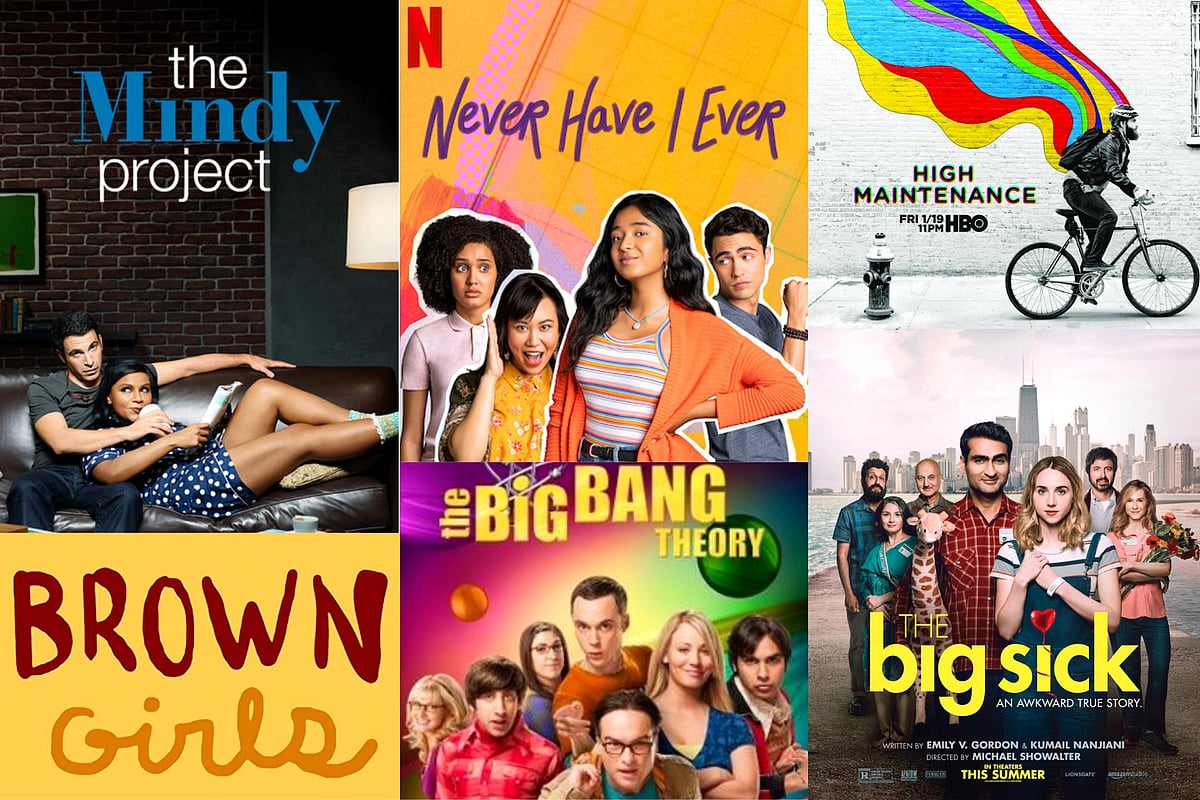
Mindy Kaling's 2012 show for Fox, The Mindy Project, was a fairly unprecedented move in American television as far as brown representation goes. Yet despite greater presence, Indian Americans are still shortchanged. They're often reduced to fit one-dimensional stereotypes that, in turn, make them palatable to a largely white audience. Either their race is incidental (which it never really is in the US) or the understanding and interpretation of what it means to be brown remains monolithic.
The Mindy Project's protagonist, played by Kaling herself, is a feisty, self-centred obstetrician-gynaecologist with a very binary, American romantic-comedy (rom-com) idea of finding love. She is portrayed as the fairly stereotypical Indian immigrant, and wants to be highly successful at her career while indulging in casual sex. Given that the show is set in New York City, it's easy to wonder why the cast doesn't involve more people of colour or why Mindy predominantly dates white men. For the most part, the show sets out to be a rom-com about a career woman, but without the very real fears of growing up brown in New York or the brutal disappointments of constantly losing out to white men at work. Mindy's brownness is almost an aside. That can be a dangerous proposition in a world where many in the majority community expect the Southasian immigrant to be a 'good immigrant' – that somehow the worth of a person of colour needs to be proven or their space at the table justified. It's almost as if by erasing the deeper fault lines from the show's writing, and glossing over the racist and sexist undertones of its white characters as 'quirks,' the viewer can embrace the deeply flawed characters with their reprehensible characteristics while ignoring the consequences of the same in the real world.
It can be argued that there isn't a 'one size fits all' version of brownness. However, skirting around the issue of race while exploring identity politics or what it means to be 'a 30-something Indian-American woman looking for love in The Big Apple' feels like a deliberate misstep. Mindy seems to have specific audiences in mind she has to cater to – the brown audience and women. It is easy to interpret her narrative as playing to the gallery, especially given her public assertion that she doesn't feel the need to offer equal representation in her show. That being said, she does make a hard tilt towards women, and briefly skims across body-positivity, ideology and divorce – making the protagonist a more globally appealing character.
So, when Mindy Kaling's project Never Have I Ever was released on Netflix in 2020, I wanted to see if the on-screen portrayal of the typical Indian American woman had progressed.