
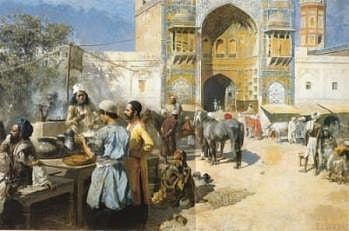
Lahore is an intense city, one that overwhelms every one of a visitor's senses. On the road, every vehicle seeks to overtake the one in front, while the frontrunners are equally determined to stay ahed. Drivers honk in unison to warn cars coming from the other direction, who in turn hoot back to demand their right of way.
Taking a walk along the busy Liberty Market roundabout is a particular experience for the nose itself. The combined stench of open sewers, overflowing waste containers and roadside eateries is overpowering, which mixes with the strong odour of rotting carrots and crushed sugarcane emanating from the juice shops. Whiffs of cologne waft from nattily dressed office-goers hurrying past burger outlets. Extravagantly dressed housewives shopping for jewellery reek of attar.
The light, sound, sight and smell of the Spring Festival at Race Course Park create an even more compelling impression. The hustle and bustle of Anarkali Market remains undiminished till midnight. Only the Lahore Fort and the Shalimar Garden still maintain the serenity and grandeur of their imperial heyday. All in all, Lahore is a quintessential Southasian city – languid, boisterous, pensive and impulsive all at the same time. Southasians from every part of the region feel instantly at home in this city of the Sikh Maharaja Ranjit Singh, whose empire once extended from the banks of the Jamuna to the Khyber, from Kashmir to Multan.
The long-overdue meeting of South Asians for Human Rights, a Track-II initiative of some eminent Southasians, finally met in March. Some SAHR participants also found themselves with a ringside view on police excesses against protesting lawyers, which took place immediately in front of the provincial assembly close to the venue of the conference. Below the city's apparent calm, resentment against General Pervez Musharraf had been building among professionals and the middle class. It erupted over a routine case of impertinence from the generalissimo. Executive intervention in Pakistan's judiciary has a long history, where 'telephone justice', dictated by influential generals, is known to have been read out by loyal judges in the courts. But the recent forced 'inactivation' of Chief Justice Iftikhar Muhammad Chaudhry enraged even docile jurists. Even as police mercilessly beat up protestors, defiance of Gen Musharraf's absolute rule had snowballed throughout Pakistan; nonetheless, the general population still seems surprisingly apathetic to the drama being played out in front of its eyes.