
(This article is part of 'Ways of eating': a mini-series on food in Southasia)
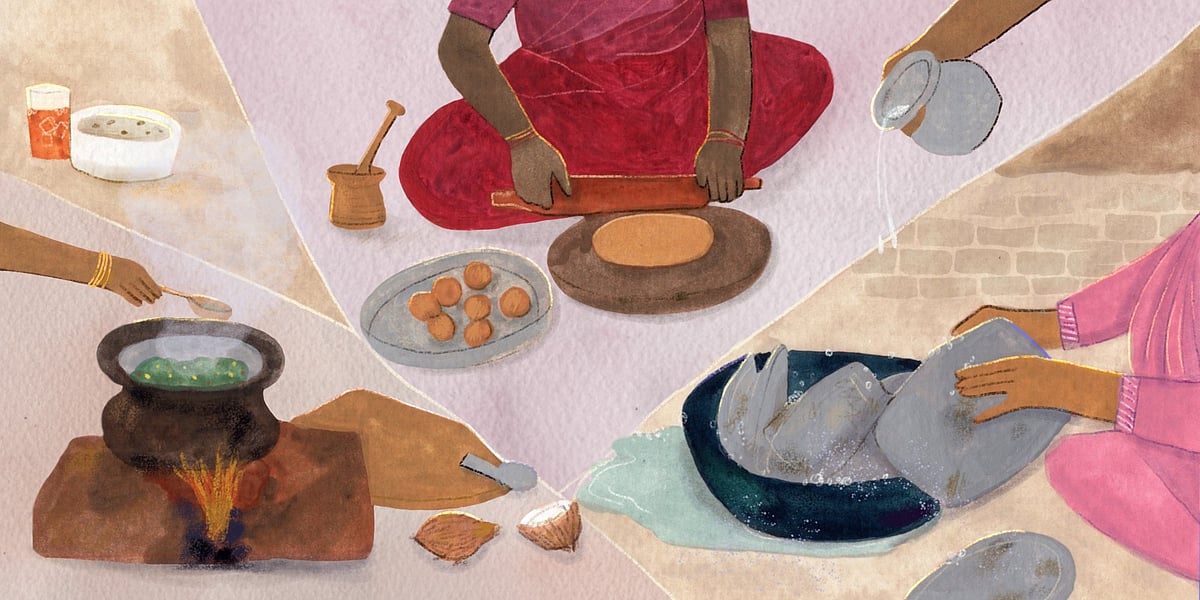
Sometimes, when I ask my father about his ancestral home in a small town in Gujarat, he tells me little details about the female spaces that he had hived away in his memory: of kolso (coal) powering the bellows of the kitchen; of his mother, my bapaiji, hunkered down on a wooden patlo tossing rotlis on the flame that was never entirely extinguished (it was kept blanketed by ash that smouldered through the night); of the rotli that was immediately yellowed with butter and sugar for a snack; of fingers of dried boomla (dried fish) charred over coal-smoke until they became crisp as icicles; of smoke-mottled copper vessels, scrubbed and scrubbed clean; of a bowl of ravo (semolina) sown with soft, fat, butter-fried raisins; of a glass of iced orange squash, the ice fresh from a brand new icebox (a novelty!). The borders of the kitchen frayed into other spaces – the window ledge on which doodh na puff (milk-cream) settles into a froth of bubbles chilled by the morning dew; the otlo (raised ground on the front porch), on which my grandmother would chat with neighbours and bargain stridently with knife-grinders and fisherwomen; the fields, in which umbadiyu was made by sealing root vegetables into a clay pot and placed on red hot charcoals, then interred in an underground pit and covered with earth overnight.
I have never seen this home. It is long gone, pulled down and replaced by a moraine of trash. These are all memories gleaned singly from conversations with my father. There is both sweetness and asperity in his telling of the day-long work of my grandmother, in kitchen air that was fuggish with coal and wood smoke. For me, in my city flat, I also think of the shared cosmologies that such a space betokens; of amity and kinship, of widened social spaces.
In his ancestral childhood home, the kitchen was a part of the back of the house, but this was not always the case. During the early colonial years, for instance, the kitchen and its inhabitants were set at a remove from the main house, the pall of smoke from wood, coal and cow dung proving insufferable to the colonial sahebs and the families. "In some rainy parts of India such as Bengal, the walkway to the kitchen was covered over but where it was not, the food was exposed to all weathers, not to mention flocks of crows or kites. There are recorded instances of a kite swooping down on a plate borne aloft by the khitmutgar and carrying off a whole roast duck, leaving a bare plate of chips," writes David Burton in The Raj at Table (1993). Burton goes on to explain that it was the influence of the British that led to some kitchens adopting standing platforms, which might explain how in the tiny fold of the world that is the Parsi colony (even those built before Independence) chose to adopt them.