
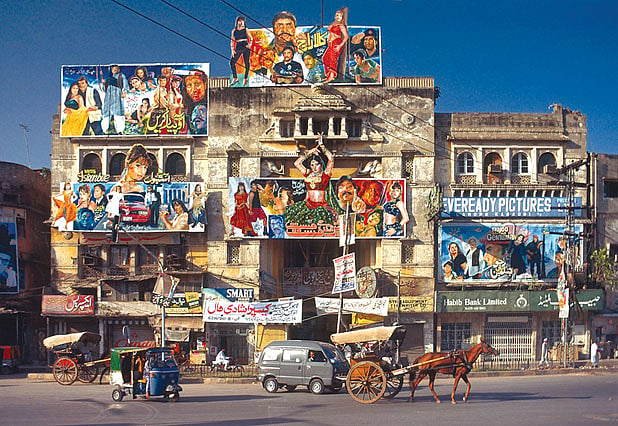
Rhyming and alliteration might be childish indulgences, but they are not without their appeal. So, if there is Hollywood, then why not Bollywood (with reference to Bombay), and if Bollywood, then why not Lollywood (with reference to Lahore)? Here, this term is stretched to encompass all films made anywhere in Pakistan and even, though only in passing, to those made in Dhaka before 1971, in an attempt to examine the intriguing world of language in Pakistani cinema. Strangely enough, the only scholarly book on Pakistani cinema, Mushtaq Gazdar's Pakistan Cinema 1947-1997, does not pay specific attention to the language of films. The only scholar who does mention language is Alyssa Ayres in Speaking Like a State, in which she references Maula Jatt which, she points out, changed a film industry that "had long indulged the genteel poetic Urdu aesthetic".
The elitism of Urdu
The Pakistani state does not impose any constraints in written documents on the language or languages that may be used in cinema. However, the 1979 Motion Pictures Ordinance does note that nothing in a film, including language, should be prejudicial to "decency or morality". People also assert that there is an unwritten understanding that Hindi words should not be used. Both examples mentioned above are part of what I call a language ideology, or a set of beliefs about language articulated by users as a rationalisation or justification of perceived language structure and use.
In Pakistan, there is a cardinal belief in a linguistic hierarchy in which English comes first, Urdu comes second, and regional languages come third. Then there is the hierarchy of varieties, of which diction and pronunciation are the main markers. In Urdu, the preferred diction was Perso-Arabic. The accent which went with it was a cultivated one based upon the standard varieties of Lucknow and Delhi. Despite protestations about the value and primacy of these linguistic traits, the directors of Urdu films settled for a pragmatic model of what some of them described as an 'educated, urban, standard Urdu' in an accent in which the letter qaf was supposed to be pronounced as /q/ (unvoiced uvular stop) and not as /k/ (unvoiced velar stop) and the letter sheen was /sh/ not /s/. However, even this preference was not uniformly practiced. Local accents were often accommodated, and in the case of a famous actress like Shabnam, a slight Bengali touch was seen as appealing. Where the champions of 'high' Urdu actually made their mark was in a deliberate avoidance of Hindi words which went so far as to eschew words of Bhojpuri and Braj. This fit in with the construction of an exclusivist Pakistani identity in which cultural and linguistic continuities with 'Hindu' India (which also meant aspects of pre-Partition UP culture) were denied. The process was accelerated by state-controlled radio and television, but in films it was carried on by directors and writers who were impelled by rivalry with Indian cinema. A documentary called Hamari Zaban (Our Language) was made by Shaikh Hasan to emphasize the iconic value of Urdu as the language of national unity, but it was not successful. Indeed, propagandist films never achieved much success, irrespective of the language in which they were made.