
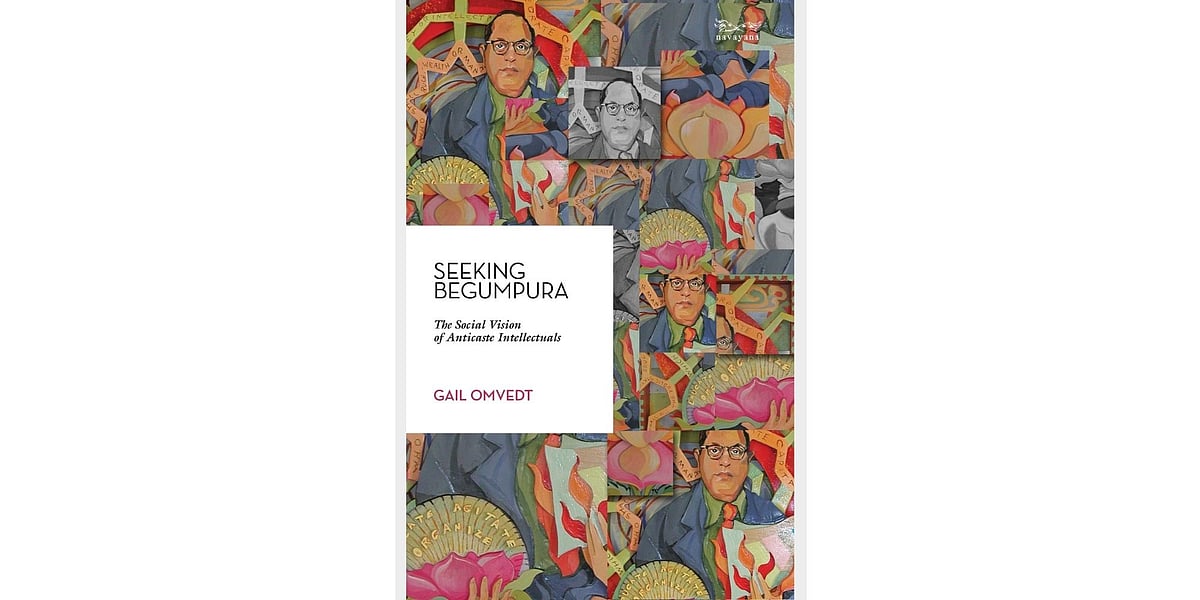
Seeking Begumpura, the latest work by the American-born sociologist and longtime Indian citizen Gail Omvedt, marks a watershed in the battle to uncover the hearts and minds of the oppressed and powerless – the 'subalterns' of the Subcontinent's history. Over the past quarter-century, two scholarly traditions have been torchbearers in this task. The first is the Subaltern Studies Group, which includes historians inspired by the Vienna-based historian Ranajit Guha; the second are the 'critical traditionalists', best known through the ideas of the 'political psychologist' Ashis Nandy.
The focus of the former group is on the communitarian peasant or Adivasi who resists the 'disciplining modernity' of the coloniser, as well as the elitism of Indian nationalists. The individual on whom the latter focuses, meanwhile, exults in what can be thought of as an 'anti-modernism' – not only preferring indigenous traditions that have been denigrated by colonial brutalities, but being almost naturally nativist. In both traditions, however, the subaltern figure is not a cultural revolutionary, but seeks instead merely to preserve his or her own cultural traditions.
Caste, meanwhile, has been largely absent from both schools of thought. In 1993, Gail Omvedt criticised the Subaltern Studies Group for largely neglecting the issue, posing the question to them: Would B R Ambedkar be considered a 'subaltern'? On the other side, Meera Nanda, a historian of science, more recently challenged the critical traditionalists by emphasising a Dalit view of modernity that does not valorise Indic 'tradition' in ways that an easy postmodernism of privileged classes, castes and gender would attempt to do. Meanwhile, the response from both of these groups to such caste-based criticism has been either dismissive (see Nandy's latest book, Time Treks) or chillingly silent.
As such, one must turn to those other traditions of scholarship that have identified and constructed the dispossessed of Southasia's history very differently. This could be, for instance, where subalterns appear as cultural revolutionaries seeking to fundamentally transform traditional culture, not simply as political radicals. These other traditions attempt to achieve this by celebrating the arrival of modernity in India as a source of potential liberation from the shackles of traditional social, political and economic orders. In this, scholars have at times taken recourse in either pre-Vedic or non-Vedic (such as Buddhist) Indic traditions, at which point oppression is seen as a product of India's traditional social order. Subaltern consciousness was, hence, directed to the fundamental modes of subjugation, along the lines of class, caste and gender.