
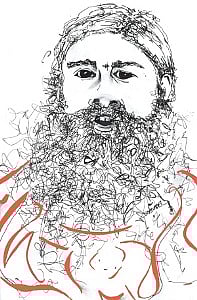
Baba Ramdev is a remarkable phenomenon. He has all the power and recall value of a B-grade Bollywood movie. Journalistic reports describe him in speeded-up time as a cascade of news. But to understand Ramdev, one has to see him less as an event and more as a structure – to read him as anthropology, unravel the myths and symbols, the politics of culture that surrounds him. Merely to see the guru as a list of categories – farmer's son, yoga expert, Yadav from Haryana, medical entrepreneur, self-made millionaire, revivalist – is not enough. Sociology does not exhaust possibilities, it helps to create them. The question one must ask is, How does a yoga guru become a political threat to an elected regime? In fact, Ramdev appears like a millennial leader promising a new moral regime.
Let us take a look at how Ramdev constructs his own world. His target is New Delhi. For him, the capital is not a place; it is a point of origin, the source that classifies categories. New Delhi is not merely exclusive – it excludes, and this is what Ramdev is battling. Given its decadence, he believes the edifice will collapse quickly. In this, Ramdev is not alone. Gujarat Chief Minister Narendara Modi speaks a similar language when he talks of the Delhi 'Sultanate'. For Modi and Ramdev, Delhi represents power that is indifferent to the rage outside it. Baba Ramdev is battling Delhi, seeing it as a source of corruption.
One has to understand the inherent symbolism. Delhi is Delhi because, as a capital, it classifies, it determines what is 'official' and what is 'informal'. In turn, these labels determine the chances that citizens have in their lives. The official is subsidised while the informal often ends up in jail. One often thinks of the distinction between official and unofficial, formal and informal in economic terms. Ramdev is suggesting, instead, that there is an informal economy of culture, an excluded domain that ranges from agriculture to language. He seeks to represent these inarticulate constituencies.
New Delhi senses Ramdev's intentions and seeks to devalue him. For many in the establishment, he is seen not as a spiritual guru but as a practitioner. Communications Minister and Human Resource Development Minister Kapil Sibal, for instance, has described him as a mere yoga guru, a specialist technician of sorts. Sibal claims that, by violating categories, Ramdev has created a law-and-order problem: a health shivir cannot be the basis for a political rally. And so, the battle of categories begins.