
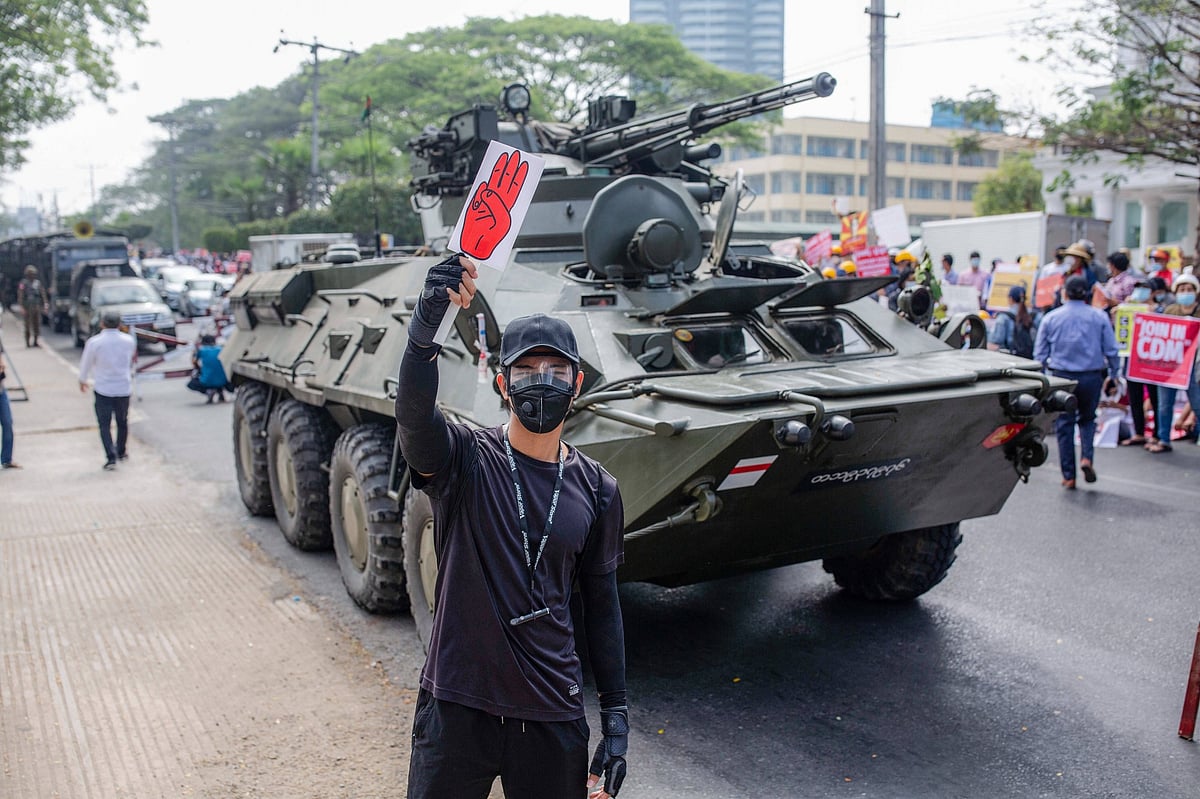
Early on the morning of 1 February 2021, a convoy of armoured vehicles carrying fully armed soldiers approached the parliament, where elected officials were ready to take office after another landslide victory for the ruling party, the National League for Democracy (NLD). The Myanmar military detained President Win Myint, de facto leader Aung San Suu Kyi and hundreds of lawmakers and government officials. Television and radio broadcasters and internet service providers found soldiers at their doorsteps, who ordered them to discontinue their services at gunpoint. Later in the day, Commander-in-Chief Senior General Min Aung Hlaing declared a state of emergency through a televised speech, citing possible voter fraud, and promised to hold a new election at an unspecified time in the future. The coup took place after the Union Solidarity and Development Party (USDP), a party of former generals, lost the election in November 2020. Unable to accept the election results, the USDP demanded a re-run of the election, levelling accusations of voter fraud, contrary to observations from independent election watchdogs that the election results were credible. But the military backed the USDP and ousted the newly elected government.
The Third Force and the army in politics
The 2021 coup is a proverbial slap in the face for everyone who believed that Myanmar's military could be a force for good. During the transitional period from military rule to partial democracy in the 2010s, many observers assumed that the military-drafted 2008 constitution, which protects the political and economic powers of the military, was the best power-sharing agreement between the praetorian military and pro-democracy groups supported by the masses. A group of intellectuals informally known as the 'Third Force' in Myanmar were at the forefront, pushing for political changes during this decade. It is hard to say exactly who the Third Force are because it is a network of loosely connected intellectuals and civil-society groups. But Myanmar Egress, a Yangon-based think tank, is widely considered to be the main driver of the Third Force movement, together with other less well-known civil societies. Founded in 2006, Myanmar Egress made it evident that its intention was to engage with the then military government as its now-defunct website says they are "nationalists committed to state building through …working relationship with the government and all interest groups".
This was not a popular stance for most observers, commentators and activists who completely rejected the military regime. During the decades-long fight for democracy, animosities developed between military leaders and pro-democracy activists. The generals and the pro-democracy camp led by the NLD were at opposite ends before 2011. Influenced by their decade-long experience in counter-insurgency campaigns against ethnic minorities, the military officers began to develop ruthless measures to contain the pro-democracy movement through mass killings, imprisonment, and torture. During the 1988 uprising, soldiers opened fire using live ammunition against peaceful protestors, killing thousands of them. The massacre of peaceful protestors occurred in 2007 and again in 2021. In return, the activists abroad lobbied Western powers to impose economic sanctions on the ruling generals and the country. The country had been in a gridlock, unable to move forward from military rule until 2011, when the nominally civilian government led by Thein Sein, a former general, launched a series of reforms.