
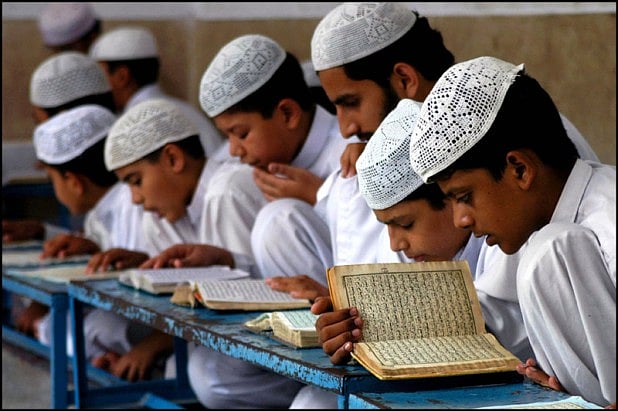
Madrassas have come to be associated with the erstwhile Taliban rulers of Afghanistan, some of whom were students of these institutions. These Islamic seminaries have also been much in the news for sectarian killings and supporting militancy in Kashmir. They are considered the breeding ground of the jehadi culture–-a term used for Islamic militancy in the English-language press of Pakistan.
There was not much writing on the madrassas in Pakistan before the events of 9/11. JD Kraan, writing for the Christian Study Centre, had provided a brief introduction in 1984. And in 1988, AH Nayyar, an academic, had argued that sectarian violence was traceable to madrassa education. Both had used only secondary sources. Later, the present writer wrote a book on language-teaching in the madrassas (Language, Ideology and Power: Language-Learning among the Muslims of Pakistan and North India, OUP, Karachi 2002), which also contained a survey of the opinions of madrassa students on Kashmir, the implementation of the Sharia, equal rights for religious minorities and women, freedom of the media, democracy, and so on. The seminal work on the ulema, and also the madrassas in which they are trained, is by Qasim Zaman. He provides an excellent review of how the traditional ulema can be differentiated from the Islamists who react to modernity by attempting to go back to fundamentalist, and essentially political, interpretations of Islam.
The ulema or the Islamists in Pakistan have been writing, generally in Urdu, in defence of the madrassas which the state sought to modernise and secularise. Two recent books, a survey by the Institute of Policy Studies (patronised by the revivalist, Islamist, Jamat-i-Islami) of the madrassas and a longer book by Saleem Mansur Khalid, are useful because they contain much recent data. Otherwise the Pakistani ulema's work is polemical and tendentious. They feel themselves besieged increasingly by Western and Pakistani secular critics and feel that they should defend their position from the inside rather than wait for sympathetic outsiders to do it for them (as done by Yoginder Sikand in Himal Southasian in 2001, "The Indian State and the Madrassa").
Type and number of madrassas