
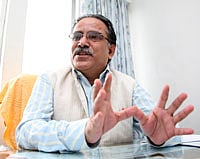
Shortly after his win, and before he formally attended office, Prime Minister Dahal sat down with the Kathmandu fortnightly newsmagazine Himal Khabarpatrika. The following is a translation of the conversation, printed here with permission.
How did you reach a consensus to form the government?
This was an effort to forge consensus amidst disagreement. We are moving ahead on the belief that, even with all of the divergences between ourselves we can achieve the kind of consensus that will take us ahead. We share an agenda of social and economic transformation with the UML, and are with the Forum on the matter of formation of a federal republic. The consensus between the three parties will guide the peace process to reach a logical solution, and will also ensure a two-thirds majority in the writing of the constitution itself.
Can this be called a natural coalition?
A coalition must be termed natural if it is likely to move in a progressive direction; but it is a forced coalition if it is regressive. Our coalition, between parties that share similar agendas, is natural and progressive. Whereas the previous alliance, between the Nepali Congress, UML and the Forum, was a dramatic coming together of contradictory forces.
How can those who call for 'one Madhes, one state' and those who oppose it work together?
We have an understanding on autonomous regions and federalism with the pro-Madhes parties. However, we have made it clear early on that 'one Madhes, one state' is not a possibility. We can have lots of autonomous provinces in the Madhes or Tarai on the basis of language, culture and geography.