
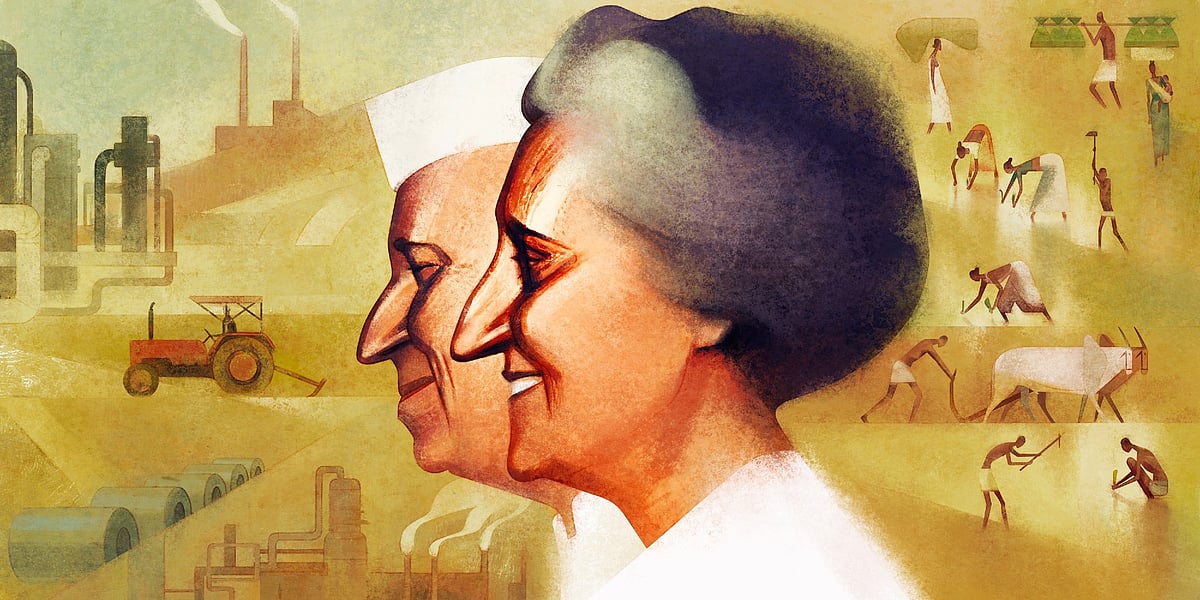
Were India's early postcolonial leaders socialists? Yes, undeniably, goes the common reflex, both on the Left and Right. To most conservatives, following the economist Jagdish Bhagwati, it took a new generation weaned off older statist shibboleths – thanks to a balance of payments crisis in the early 1990s – for India to unfetter itself from the shackles of Congress socialism. To most left-liberals, on the other hand, Jawaharlal Nehru and Indira Gandhi's years in office – 1947-64; 1966-77 and 1980-84 – were a golden age of welfarism, a world removed from the neoliberal depredations of our time. As it happens, both views rest on a flawed premise. For both exaggerate the differences between early and late postcolonial India.
Indeed, a closer look reveals that continuities count for more than differences. Nehru and Gandhi may have been self-professed socialists, and their successors their equally self-styled critics. But for all that, their styles of rule, and the kinds of state apparatuses they presided over, were remarkably similar. The Nehruvian state, much like the contemporary Indian one, was an emaciated affair. The radical Left, then as now, was seen as an enemy of the state by Delhi's incumbents. If to prime ministers Manmohan Singh and Narendra Modi, India's Maoists were, variously, 'the greatest internal security threat' and 'monsters' with 'evil mindsets', unworthy of dialogue and fit for elimination, to Nehru and Gandhi, their predecessors were no better. Happily, Nehru put down the communist insurgency in Telangana with brute military force in the late forties, rescuing landlords from the wrath of the peasantry, which was living in near-feudal conditions. Around the same time, disillusioned Congress socialists left for the Socialist Party when it became clear to them that Nehru's party was disinterested in land reform. Moreover, they sat out the writing of the Indian Constitution, tasked as it was to an indirectly elected body whose members were selected as representatives of their ethnic communities by a tiny, landed and elite electorate – unjustifiable to the Socialists but perfectly reasonable to Nehru. Later, when the Socialist Party courted a merger with the Congress, Nehru actively discouraged it; it never went through. Likewise, he kept at arm's length from the faction that tried pushing his party to the Left, the Congress Socialist Forum. Party unity trumped socialism proper. And famously, joining forces with the Muslim League and Christian groups, he threw out the world's first elected communist government in Kerala in 1959.
The same was true of Indira Gandhi's regime. During her premiership, cadres of the Communist Party of India (Marxist) were consigned to torture chambers in Kerala, and Bengali Maoists incarcerated wholesale. After riding on the coat tails of the Congress Forum for Socialist Action (CFSA), the pressure group that helped her cling onto power in 1969 after the party split, she unhesitatingly turned against it in the early 1970s, by which time it had become a liability: "Do these people want another split in the party?" It was disbanded soon after. In 1975, she carried out a self-coup by declaring a state of emergency, banning the Maoist Naxalite movement and arresting CPI(M) cadres, socialists, trade unionists, and even leaders of the Congress Left. For the period of the Emergency, all fundamental rights were suspended save one: the right to property. As for promises to bring the commanding heights of the economy under public control, these were quickly forgotten: so much so that Gandhi announced a moratorium on nationalisation. Moreover, while Parliament was amending the Constitution to reflect that India was not only a 'sovereign' but also a 'socialist' republic, Gandhi was telling the press that education and welfare cuts were necessary to give tax breaks to the top one percent of Indian earners. A year into her final term, in 1981, she pushed through an amendment of the Essential Services Maintenance Act; aimed at disciplining labour, it made it easier to ban strikes, imprison workers, and use military personnel as blacklegs. She was also behind what was, perhaps, the most brutal suppression of the labour movement in Indian history: in 1982, the textile strike in Bombay was put down with the help of police and paramilitary forces, leaving 150,000 workers unemployed.
The elusive socialist leader