
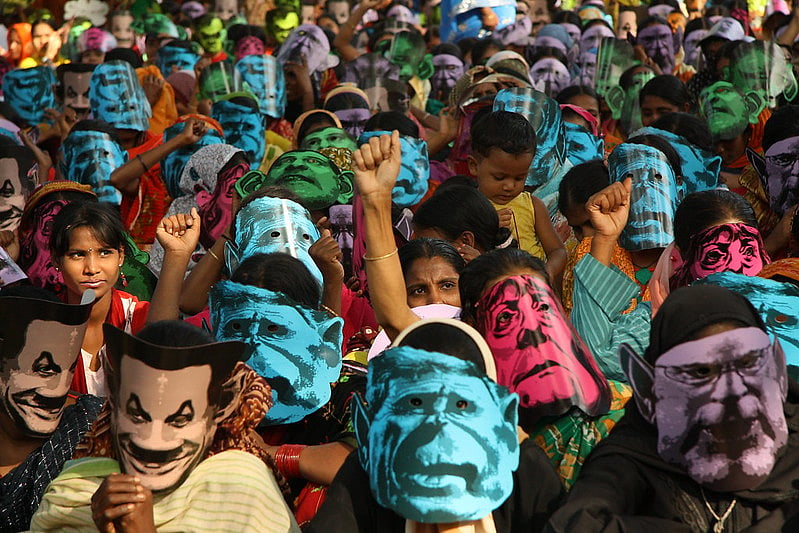
Climate change has become the defining issue of our time. It is a quintessential global matter, since its effects respect no national or regional boundaries. Climate change is also a challenge that compels a global and collaborative response. We are all literally in the same boat, cast adrift in increasingly tumultuous seas. Unless we pull the oars together we may not make it to shore.
It is precisely this kind of collaborative response that must be constructed when we all meet at the 15th Conference of Parties to the UN Framework Convention on Climate Change (UNFCCC) in Copenhagen in December. Success at Copenhagen is particularly important for developing countries such as those in Southasia, since it is we who will suffer the most adverse consequences of the changing climate. While delegations of Southasian countries have had good consultation and cooperation among them as part of the larger G-77 and China grouping, we have not yet managed to project the specificity of our own regional situation at the multilateral negotiations currently under way. This is important to do, because Southasia is home to 1.3 billion people – we constitute one-sixth of the world's humanity.
Decision-makers of the region have a grave responsibility to safeguard the interests of the people of Southasia, to ensure their survival with a reasonable standard of living in any global climate-change regime that may emerge at Copenhagen. Ours must be a collective voice seeking more significant action from those who have been responsible for the accumulated greenhouse-gas emissions in the Earth's atmosphere. The industrialised countries must take the lead in committing themselves to much deeper cuts in their emissions, and deliver on their legal obligation enshrined in the UNFCCC. These include the obligation to transfer technology and funds to developing countries, to enable the latter to adapt to climate change and to undertake mitigation actions that are beyond their own limited resources. Ours must be a voice seeking not only an ambitious outcome at Copenhagen; it must, first and foremost, be a voice demanding equity and fairness. It is my hope that the awareness of the gravity of what climate change portends for the people of Southasia will lead us to shed our differences and work together on a common platform at the negotiations.
While climate change is a global and cross-cutting challenge, its impact is felt locally and regionally. The specific features of our region – its geographical location, its demographic profile and its level of development – determine how the changing climate will specifically impact on the lives of our citizens. There is no doubt that the effects of climate change will inevitably compound the stresses our region is already facing due to demographic pressure, the strains generated by economic and social change, and continuing poverty. We therefore need to evolve a Southasian perspective on climate change, taking into account the particularities that characterise the region.