
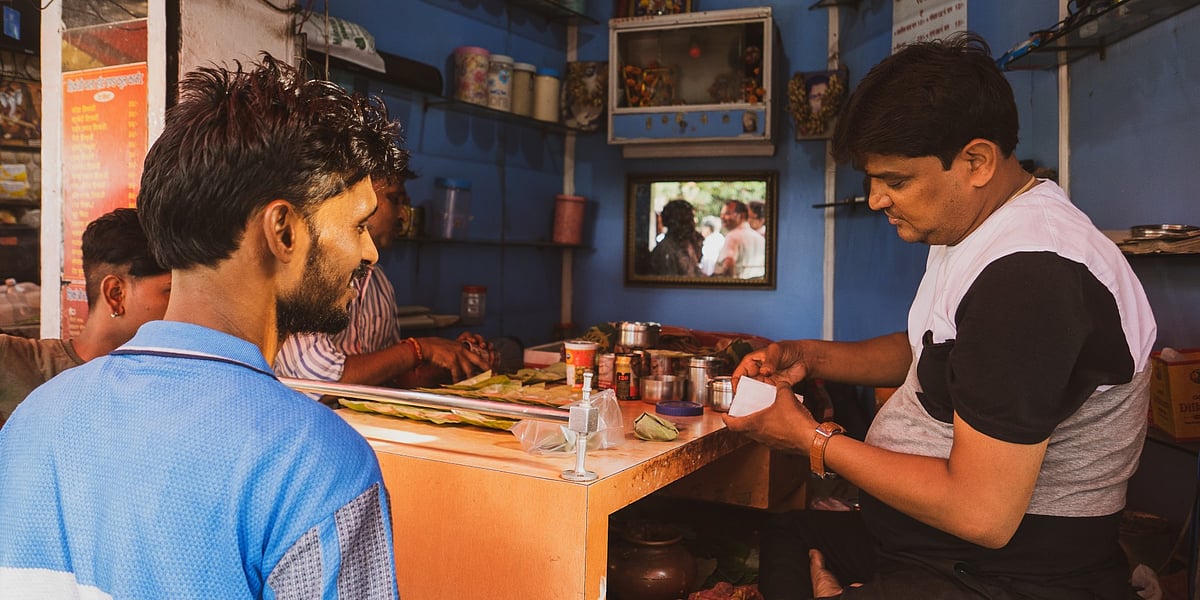
The Sufi poet Amir Khusrao depicts in exquisite verse the paradigmatic protagonist of the Southasian street, the paanwallah – or seller of paan. Paan exists in a culinary category of its own: simultaneously a dessert, a stimulating narcotic, a post-meal palate cleanser and a herbal digestive. Its fresh, peppery, bitter, sweet-spicy flavour has refreshed Southasian mouths for a millennium.
The culture of paan manifests as a leaf-wrapped comestible, as red-stained streaks of spittle and as ramshackle stalls on street corners. The skilled producer of this complex victual, the paanwallah, is an omnipresent figure on bustling pavements, on the silver screen and in the entanglement of the lives that populate the Indian subcontinent. The paanwallah has always captivated me: during my childhood, when my father and I queued up at his stall to cleanse our mouths after a spicy meal, and now, as an observer with an ethnographer's curiosity and a student's homesickness.
The paanwallah is a fascinating figure – simultaneously a source of hedonistic refreshment, an arbitrator of social interaction, a curator of cultural ceremonies and a maestro of a culinary craft. His practice combines consumerist customisation with ritualistic gastronomic patrimony, while paan consumption extends beyond just mastication to become a communal rehearsal of the idiosyncrasies of society. Akin to the triangularity of the paan, this piece paints a triptych of the paanwallah – of the person, his place of work, and his practice – as the bustling heart of the subcontinental street, and at the cornerstone of urban publics, politics and poetics.
Paan: A primer