
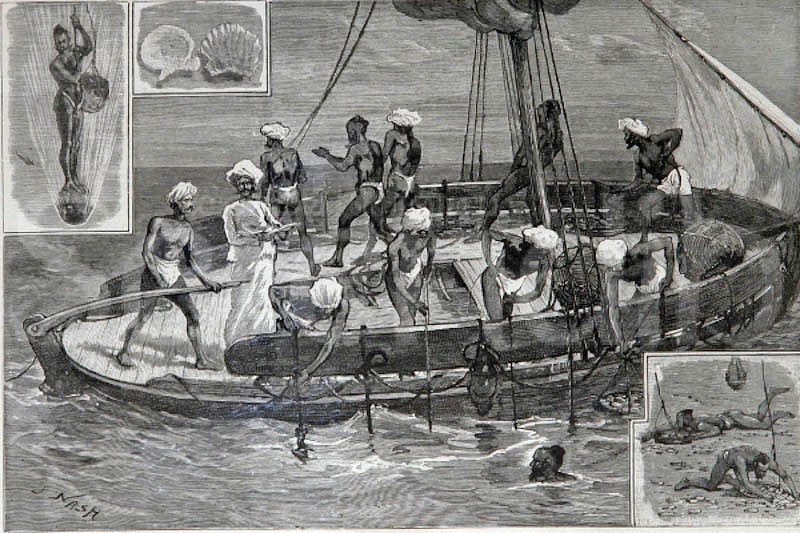
The divers were predominantly Tamils or Arabs. Some plunged headfirst from springboards; some descended in an upright position, carried down rapidly by a stone or lead weight. They worked in pairs; one diver remained on the surface, along with an assistant or munduck who watched over the ropes attached to the weight and the basket in which the oysters were collected. When ready to descend, the Tamil diver pinched his nostrils shut, while the Arab diver used a horn clip.
Of the world's great pearl fisheries, none can compare with the fishery of the Gulf of Mannar. Over 3000 years ago, pearls were one of the principal sources of revenue of the Tamil kings. In ancient Rome, the author and philosopher Pliny referred to this fishery as the world's most productive. The Greeks, Venetians and Genoese all sought the beautiful specimens harvested in these waters. The Pearl Banks (paars) stretch from the island of Mannar, off the northwestern tip of modern-day Sri Lanka, south to Chilaw, at depths ranging from five to 15 fathoms. The shallow undersea plateau on which the banks are located varies from 32 kilometres wide in the north to six km in the south. Traditionally, each of the 50 or so banks bore a unique name, the most productive being the Cheval and the Moderagam.
Pearl fishing was such an important industry that it was a government monopoly from the earliest times. There were two distinct fisheries – one on the South Indian coast, the other on the Sri Lankan coast, in Mannar. However, the fishery off Mannar was considered the most important. Megasthenes, the Grecian ambassador to the court of Chandra Gupta in the third century BC, asserted that this fishery produced larger, better quality pearls.
In colonial times, divers did their work from 15-ton dhows from the Persian Gulf, which carried a crew of 14, along with ten divers. The fleet, often numbering 400 boats, left for the Pearl Banks in the early hours of the morning. 'The boatpeople are raised from their slumbers by the noise of horns and tom-toms, and the firing of a field-piece,' remarks one James Cordiner in A Description of Ceylon (1807). After going through what Cordiner describes as 'various ablutions and incantations', the pearl divers set sail for the Pearl Banks, guided by pilot boats. By sunrise, the fleet was anchored in position around a barque carrying a government 'inspector' of the Pearl Banks. An hour after sunrise a gun was fired, which gave the signal for diving to commence.