
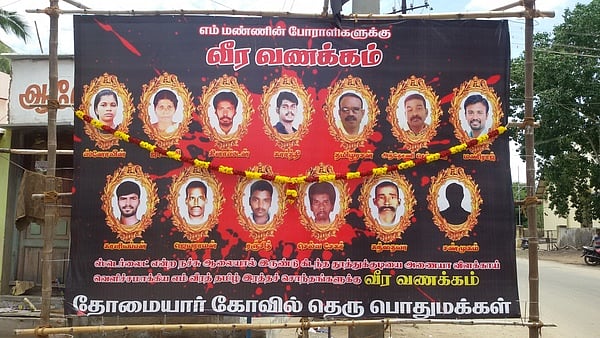
The road winding through the industrial complex of the State Industrial Promotion Corporation of Tamil Nadu (SIPCOT) at Tuticorin, or Thoothukudi as it is known locally, runs past the multinational mining corporation Vedanta's copper smelting complex, Sterlite, with its ancillary plants and captive power generating units. Almost since the day it was set up in 1996, the plant has been perceived as a death knell by Tuticorin's residents, a source of endless toxins making their way into the air and water. When this writer visited the area, ten days had lapsed since the eruption of a maelstrom of public fury that had played out a short distance away in the heart of Tuticorin. As crowds of anti-Sterlite protestors thronged the city on 22 May, local police fired live ammunition at them, causing people to "drop like birds", in the words of one protestor.
Here, outside the Sterlite complex itself, everything now had assumed an almost zen-like calm. The Tamil Nadu government was forced by the sheer weight of public sentiment to order the closure of the plant, and it was now being guarded like a fortress, with police jeeps and officials milling around it, even as a bulky Varun – the police riot-control vehicle of choice in this part of the country – stood sentinel outside the gate with its water canons at the ready.
Police protection for Sterlite.The gargantuan outline of the now shut-down plant, with its smokeless chimney stacks, brings to mind the Union Carbide factory unit, which continues to smoulder in the old city of Bhopal to this day. The gas leak from the carbide factory had killed thousands in 1984 and was then seen as a watershed moment that would lead to policy regulation and the exercise of political will to prevent another such disaster. In his book Bhopal: The Inside Story, T R Chouhan, a worker in the factory, had documented the many signals of a disaster foretold that had emerged from the Union Carbide plant while it was in operation. He recalled how a plume of poison gas had leaked through a faulty joint and made its way to the sleeping neighbourhoods around the factory during one of his night shifts two years before the world's biggest industrial disaster unfolded on the night of 2 December 1984.
At the Sterlite plant, there have been several such intimations of disaster, each of which have been documented in painstaking detail by local environmentalists. In 1997, a year after it was set up, there were two episodes of gas leaks which made several people in the vicinity grievously ill. In March 1999, 11 staff members of a nearby All India Radio station had to be hospitalised after breathing in the poisonous air emanating from the complex. More recently, after a major gas leak in March 2013, sulphur dioxide levels in one of Sterlite's plants had touched a level almost three times the permissible limit.