
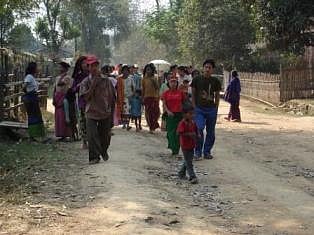
Last December, more than 1500 people living along the Burmese border in Manipur suddenly began leaving their villages, in flight from a counter-insurgency operation by the Indian Army against cadres of the Manipur People's Army (MPA), the armed wing of the nearly 43-year-old insurgent group United National Liberation Front (UNLF). The Indian Army had just begun a major operation to purge MPA cadres from an area the insurgent group had been calling a "liberated zone". Heavy artillery bombing and mortar shelling followed, and intermittent encounters between the two forces were also reported.
The Indo-Burmese frontier in the southeastern part of Manipur is almost devoid of the presence of state authority and government infrastructure. When this writer trekked into the area a few weeks before the military operation began, the army controlled the area up to Hengshi in Chandel District, beyond which the insurgents held sway. Caught in the crossfire, the predominantly Kuki-Chin villagers on both sides of this line were living a life of daily uncertainty.
As the fighting intensified during the following days, villagers from Chandel District, southeast of Imphal, began converging at a village called Molcham, seeking safety in numbers. They were soon moved out of this area, however, allegedly by the army, to a village called T S Laijang, near a new army post. The UNLF has charged the military with having used the villagers as human shields, and of herding them away – under the guise of humanitarian intentions – so that they would not be able to speak to the press about their experiences of the counter-insurgency operation. The army has denied all such accusations.
Another 300 villagers from Molcham managed to make it to the border trading town of Moreh, where another controversy erupted. The refugees were initially provided relief by a local NGO, but were whisked away the day after their arrival to T S Laijang under controversial circumstances, allegedly by members of two Kuki organisations – the Kuki Students' Organisation and the Hill Tribal Council – in an act said to further the interests of the Indian Army. A group of journalists and state-assembly legislators were due to arrive at Moreh to meet the group just as it was being taken away. As with the previous incident in T S Laijang, the UNLF characterised the move as an attempt to forestall the villagers from telling the true story of what had taken place in Molcham.