
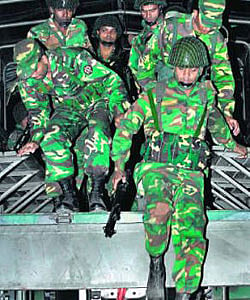
The unslain demons of Bangladesh's politics have returned to haunt a democracy that the small Southasian state has struggled to preserve for nearly two decades. On 22 January, Bangladesh was supposed to go to the polls to elect a new government. Instead, the elections have been scrapped, the democratic political process has been derailed, and a military-backed interim government now rules the country by fiat. Had the political standoff of the first week of January persisted, there is little doubt that a bloodbath would have ensued.
Over the past three months, the streets of Dhaka have seen a kind of political violence that has become all too familiar. Police and protestors exchanged volleys of teargas shells and Molotov cocktails that left hundreds injured – all the while egged on by political masters for whom any means is justified to achieve power. Transport blockades crippled the economy, particularly hurting the urban poor, who lead a hand-to-mouth existence. The lucrative apparels industry, which contributes to the vast majority of the country's export earnings, was reporting losses of millions of dollars. By 11 January, when a state of emergency was declared and a gentrified coup d'état by a civilian administration took place, the country's politics were perched on the edge of disaster.
At the heart of the protests that bedevilled the elections is a crude power struggle between the two major political parties, the Awami League (AL) and the Bangladesh Nationalist Party (BNP), which had relinquished power in late October to a caretaker government that was to oversee the polls. The former, leading a 'grand alliance', was set to boycott the elections, accusing the arch-rival BNP of rigging the voter list with phantom names during its five-year tenure in power. These contentions have been confirmed repeatedly, including by a recent study by the US-based National Democratic Institute for International Affairs, which reported that the voter rolls did indeed have more than 12 million names that were either "errors or duplicates". The AL also claimed that the BNP and its coalition partner, the religious, rightwing Jamaat-e-Islami, had planted BNP-friendly bureaucrats in both the Election Commission and the interim government that was empowered by the Constitution to conduct the elections.
In a move that may have averted an imminent crisis but perhaps doomed the eventual elections, President Iajuddin Ahmed, appointed during the BNP's 2001-2005 tenure, assumed the role of Chief Adviser to the interim government in the last days of October (See Himal December 2006, "Trying times for the Bangladeshi democrat"). After that, Ahmed systematically prevented every attempt by his interim cabinet to ensure the neutrality of the electoral process – including resisting the removal of the controversial Chief Election Commissioner, M A Aziz, who in turn had strenuously attempted to prevent a correction of the erroneous voter rolls.