
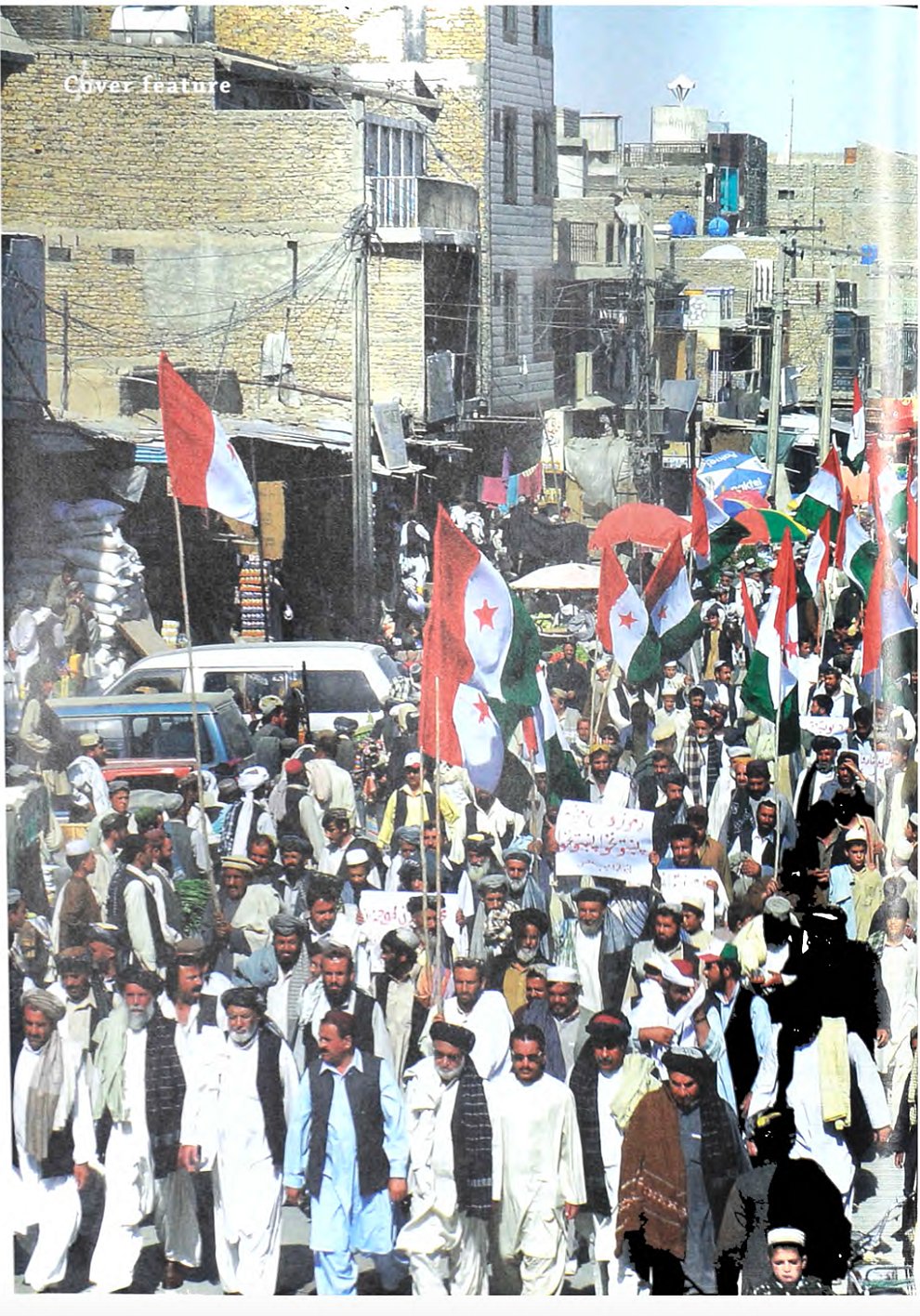
If you see the flag of Pakistan in Balochistan, you are either on the Balochistan University campus in Quetta or at the provincial assembly – or, more alarmingly, within metres of a checkpost manned by the Frontier Corps (FC), the paramilitary force that controls the province. Nowhere else in this, the country's largest province by area, will you see the national flag. On the contrary, flags of Azad Balochistan are a dime a dozen, adorning shops, houses, streetlights and random poles. Schools in the province – even those administered by the government – start their day not with 'Pak ser zameen' (the national anthem), but with 'Ma chukki Balochani', the anthem of Azad Balochistan. Here, the Pakistani state, army and paramilitary forces are figures of hate, while the sarmachar (Baloch 'freedom fighters') are considered heroes.
To get to such a point, the relationship between the Baloch and the state has been mouldering since Independence. The manner in which, for instance, the province was used for the nuclear tests of 1998, and then left to deal with the fallout, is perhaps indicative of the way the Baloch have been treated by the state for the past 63 years. The nuclear tests of 28 May 1998 hold a special place in both the state's narrative of victory and in the minds of many Pakistani citizens. While the latter are generally aware that the tests were conducted in the mountains of Chaghai District of Balochistan, very few know about the aftermath of these blasts for the residents of Chaghai, where nuclear fallout has since contaminated groundwater and wreaked havoc on agriculture. This has given rise to a host of diseases and deformed births – phenomena that are often referred to simply as 'mysterious illnesses of Balochistan' and brushed under the carpet.
When the Pakistan People's Party (PPP) swept into power in 2008, after almost a decade of military rule, many saw it as the harbinger of a new era of reconciliation. This optimism was bolstered when President Asif Ali Zardari took the unprecedented step of apologising to the Baloch nation for the decades of deprivation and oppression. The president's apology brought a wave of goodwill towards the Baloch, particularly from the intelligentsia, which had, in the past, attempted to brush aside Baloch nationalist sentiments as criminal or 'anti-state' activities. The official apology also brought hope for betterment in state policy for the province. Since then, however, Islamabad has shown little sincerity in understanding or improving the lot of Balochistan, where the civilian government is struggling to deal with increasing militarisation. The latter has also served to alienate and radicalise the population in general.
Alienation of a nation
For outsiders, Balochistan is largely marked by glorious sunsets, stark desert scenery and majestic rocky mountains; life on the ground, however, is in striking contrast to such beauty. The rule of law holds little meaning in a situation where the people are often seen by the state as a violent 'other' who must be quelled for the security of the 'nation'. This narrative is held in place by a systematic, brutal campaign aimed at silencing all voices of dissent – and keeping alternative perspectives from finding their way out. Reading the morning papers or watching the evening news elsewhere in Pakistan, one could conveniently forget that the country's largest province is – and has been for the past several decades – at war with the state. Since information coming out of Balochistan is subjected to strict state control, few outside the province are aware of the increasing, and increasingly brutal, role of the FC. Nor do most Pakistanis elsewhere understand the exact extent of the indigenous independence movement, the opposition to 'development' around the new Gwadar port, the annexation of land by the armed forces, the widespread sale of agricultural lands to outsiders, or the number of people who have been 'disappeared' by the intelligence agencies.