
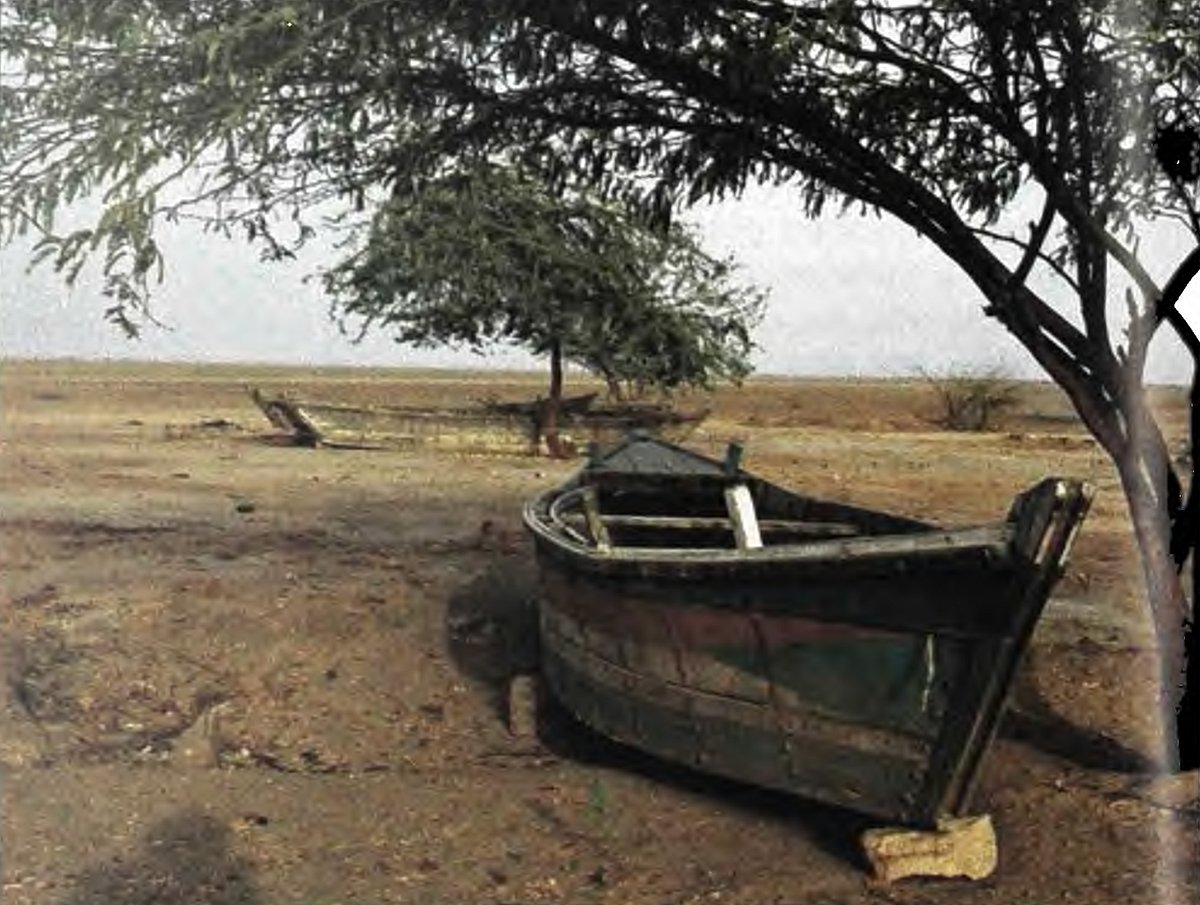
The road to Dholavira cuts across a dazzling white landscape of salty mudflats. It is close to noon in early April, and the mercury is already past 100 degrees Fahrenheit. The desert monotones are interrupted only by the striking attire worn by the women of the nomadic and semi-nomadic pastoral communities that continue to inhabit this land: the Ahir, Rabari, Jat, Meghwal and others. When I ask the driver of my hired car to stop for a photo, they receive me with curious stares and giggles.
This is the Rann of Kutch, an area about the size of Nagaland that is almost entirely within Gujarat, along the frontier with Pakistan. Once an extension of the Arabian Sea, the rann ('salt marsh') has long been closed off by centuries of siltation. During the monsoon, large parts of the Rann fill up with brackish water, enough for many locals to harvest shrimp. Some of these fishermen abandon their boats on the drying mudflats, presenting a surreal scene to dry-season visitors. Heat mirages abound, making distant objects hover strangely above the land. Further to the east, in the Little Rann of Kutch, is a wildlife sanctuary that protects the Asiatic wild ass, a shy and handsome animal that can sprint at speeds of up to 70 kilometres per hour. Now reduced to about 2800 in number, the wild ass depends on the few bets, or grassy islands, nourished by monsoon rains. The sanctuary also contains a large number of local and migratory birds, especially flamingos, in its many wetlands.
The humans that live in this area lead an existence that is every bit as precarious. Dotting the parched landscape are desolate desert-like encampments, where a family or two combine forces to eke out a living by mining salt from the saline groundwater, the largest local industry. Local legend has it that when a salt worker dies and is cremated, the soles of his feet survive – a lifetime of saltpan labour bakes them so hard that even fire cannot fully consume them. The mined salt is eventually transported in Tata lorries to small trading posts along a nearby railway line. In the dry season, as far as the eye can see the land is dotted with hillocks of salt, where the precious mineral is packed and sent out on the trains for further processing.
Larger human settlements in the Rann of Kutch are limited to a few island-like plateaus above the salt flats. One of these, Khadir, hosts the remains of the ancient city of Dholavira, discovered in 1967 and only excavated since 1989. While hundreds of sites from the Indus Valley Civilisation have been identified in Gujarat alone, the ruins of this 5000-year-old metropolis are among the six largest known in the Subcontinent, along with the Pakistani sites of Mohenjodaro in Sindh, Harappa and Ganeriwala in Punjab, and the Indian sites of Rakhigarhi in Haryana and the port town of Lothal, also in Gujarat.