
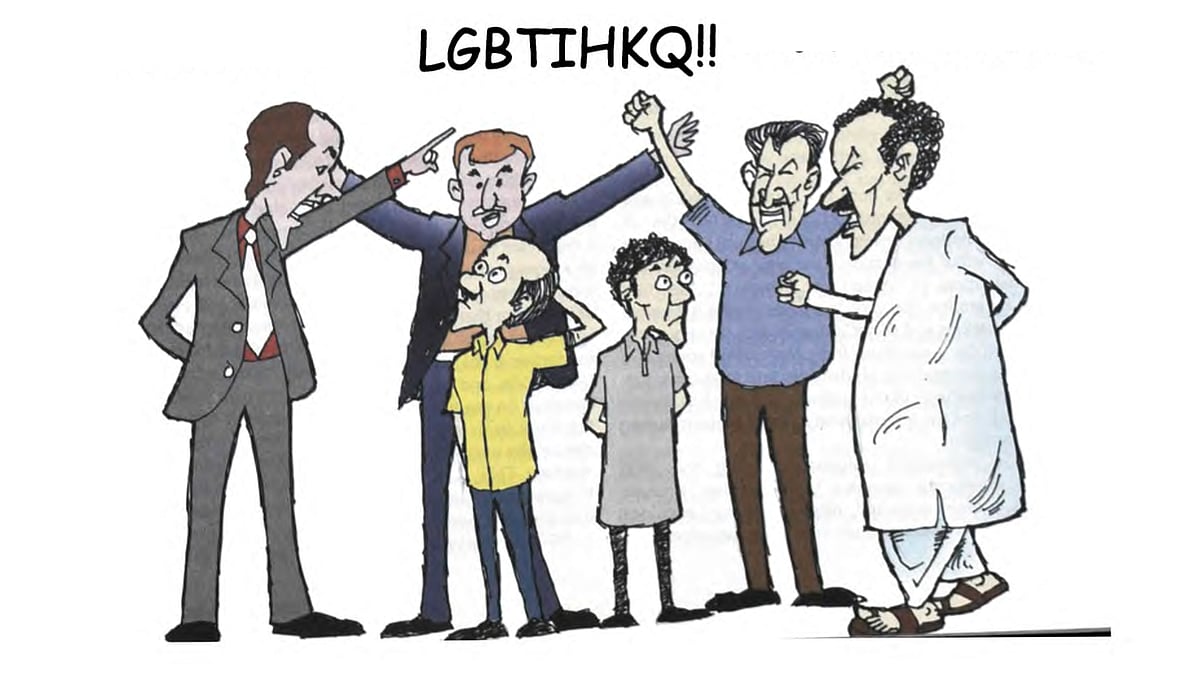
An observer would be forgiven for looking at the current proliferation and variety of conversations on same-sex politics in Southasia, and making some assumptions: that sexuality has finally arrived in the region as a mainstream issue of debate; and that the challenges posed by same-sex-based politics have truly shaken up the region's societies. But nothing could be further from the truth. Unlike the women's movements in our countries – or various other struggles, whether against dams or for tribal rights – the same-sex 'movements' in this region have never been grounded, autonomous movements. While the women's movement and other causes may have eventually been co-opted by NGOs and the institutionalised mindsets that surround them, those dealing with same-sex sexuality have been NGO-based from the very beginning.
Same-sex politics in Southasia originally piggybacked on the brigade of civil-society organisations that were focusing on HIV and AIDS during the 1990s. Indeed, funding for HIV-related issues in India alone increased exponentially, from INR 1.4 billion in the early 1990s to nearly INR 7.1 billion in 2007. With this influx of funding, from a plethora of international agencies, it comes as no surprise that NGOs have clambered for a share of the pie. In particular, same-sex-focused groups attached themselves to this funding wave, and thus defined themselves through these NGOs. First and foremost, this tendency has been deleterious for those impacted by AIDS who have most needed this funding. Same-sex-identified populations, after all, are not the worst affected by the HIV/AIDS epidemic in Southasia; the primary categories with the disease are instead made up of economically poor mothers and their children, patients receiving infected blood in hospitals, and injectable-drug users.
The conflation of same-sex issues with those of HIV and AIDS has also led to a cottage industry of sexuality-focused NGOs, often run by middle-class 'entrepreneurs'. Such organisations base their operations on funding, and have thus involved themselves in the full-time manufacturing of new target populations and identities – such as the absurd kothi, an 'identity' that refers to cross-dressing, largely working-class men who are not hijras (the third gender in Southasia) but who have sex with men. As a term, 'kothi' suddenly emerged during the 1990s, and is now taken as a given. All the while, these groups continue to increase the vast alphabet soup of identities (for instance, LGBTHKQ … the letters could really go on), even as they maintain a primary eye on keeping their NGOs in business. How can any change be expected if the fire that comes from self-identifying as 'gay' – a term with a long history – has been replaced by suddenly grafting a new word onto populations, largely without their knowledge or input?
In recent years, queer has become bandied about as the new popular term. This is a word with a very specific history, mainly in US academia, but suddenly whole groups of people are being referred to as 'queer' in India and elsewhere. But in fact, queer, an English-language and remarkably vague word, is one that only has resonance in the middle and upper classes, among folks who do PhDs in the US and write to US-based funding agencies for money to carry out their 'queer' studies in Southasia. NGO activists in the region now utilise this word – currently in favour with donor agencies – and set about purporting to selflessly garner funds on behalf of beleaguered populations. These populations, inasmuch as they see themselves as groups, do not have a fixed language for how they describe themselves, but rather complex forms of self-identification and community that need to be studied carefully.