
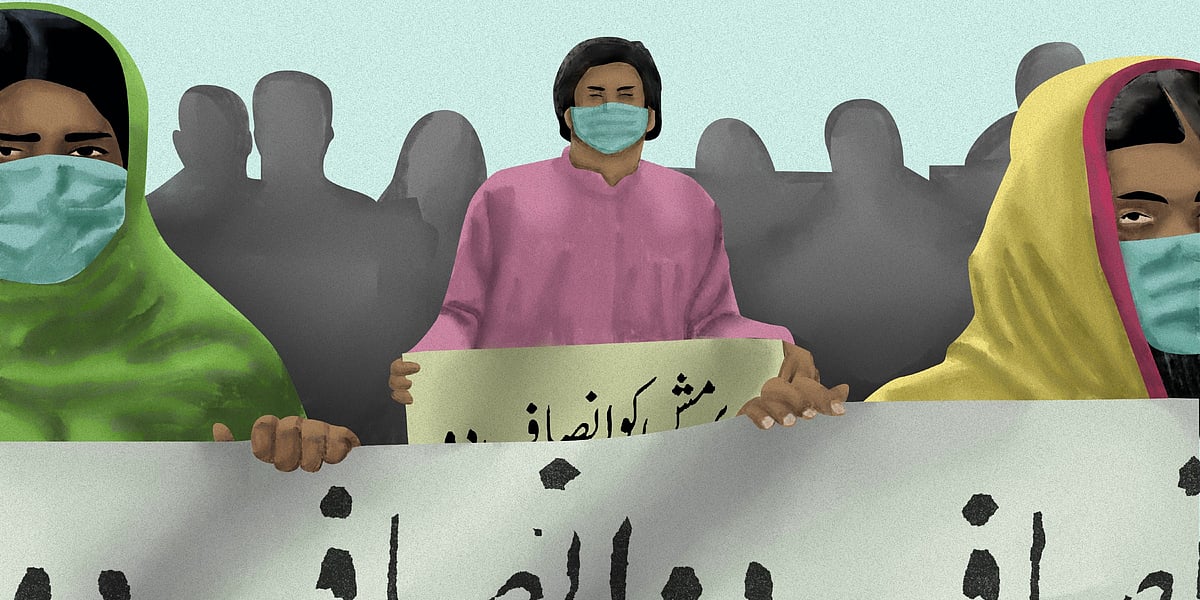
(This article is part of our special series Unmasking Southasia: The pandemic issue. You can read the editorial note to the series here.)
The last public protest I attended was on 8 March 2020. Two weeks later, the world changed. It was already changing, of course – had already changed, perhaps – but we didn't know yet how much or for how long. That day, the gardens surrounding Karachi's Frere Hall heaved with humans, mostly women; in a satisfying inversion of the status quo, men were allowed only in the company of a woman or a non-binary person. First, we shuffled, single-file, through a metal detector; the day was muggy, and, if we carried water, we had to first sip it under the watchful eye of an organiser, so she could make sure we weren't smuggling acid onto the premises. Guns, explosives, acid attacks – these were familiar threats. What we hadn't yet learned to fear was the simple presence of other humans – their breath, their touch, the threat of contagion.
Many young Pakistani women will tell you that the Aurat March, a feminist movement that culminates in countrywide demonstrations on International Women's Day, was their first experience of old-fashioned, flesh-against-flesh political engagement. In a region heavily segregated along gender, class and religious lines, public and collective forms of resistance hold immense power. But as COVID-19 maintains its grip on the world, has this form of politics become impossible?
According to the Armed Conflict Location and Event Data (ACLED) Project, a US-based organisation which tracks unrest across the world, the frequency of protests plummeted across Southasia in March 2020, declining by nearly 300 percent from the start of the year. But this dramatic decline didn't necessarily imply that resistance had dissipated. As large swathes of the world locked down, a research team led by political scientist Erica Chenoweth began collecting data on the various methods people were using to express solidarity or press for change in the midst of a global crisis. "Far from condemning social movements to obsolescence," the researchers argued, "the pandemic – and governments' responses to it – are spawning new tools, new strategies and new motivation to push for change."