
The issue of Kashmiri Pandits has been a recurring and prominent theme in India's national politics. In our last column for Himal Briefs, we discussed how the film The Kashmir Files negatively presented Kashmiri Muslims, which led to Islamophobia and attacks across the country. The Hindu right-wing government and its ideological mentor – the Rashtriya Swayamsevak Sangh (RSS), promoted the film. The RSS chief Mohan Bhagwat's statement referred to Pandits as "devout Indians", positioning them as a pro-Indian and nationalistic subset of the Kashmiri population, who will work for India's interests in the region. This has made the minority prone to attacks. In April, the statement was made to a group of Kashmiri Pandits wherein Bhagwat also heaped praise on Israel and Jews who struggled for their "homeland" and succeeded. Such a statement, when the fear of demographic change has engulfed the entire region, is bound to have serious consequences.
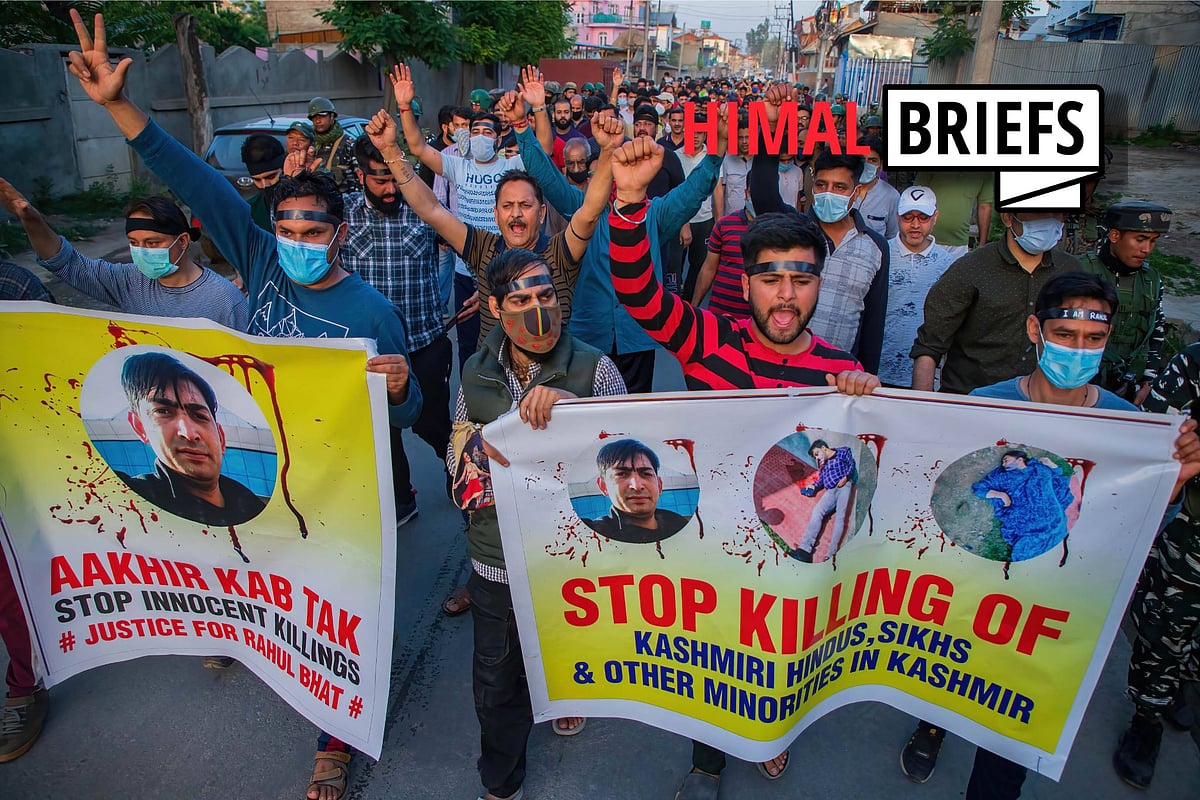
Around 18 Kashmiri Pandits and migrant Hindus have been killed as of June 2022 since the abrogation of Article 370 in 2019, which granted exclusive property and employment rights to the native population. In the last few months, particularly in May (a month after RSS chief's statement), there has been a spike in civilian killings in Kashmir. Rahul Bhat, a Kashmiri Pandit who worked in the revenue department in central Kashmir, was shot dead in his office on 12 May. On 31 May, Rajni Bala was killed after being attacked outside a government school in south Kashmir where she worked as a teacher. Several migrant labourers from India were targeted in deadly attacks since the change in Kashmir's special status. Militant groups like Lashkar-e-Taiba and The Resistance Front have released statements justifying these attacks as retaliation against attempts to settle outsiders and change the demographics of the region. Many security experts have pointed to the changing nature of militancy in Kashmir – the recent attacks were well-planned, and their targets were strategic.
Attacks on Kashmiri Pandits and migrant Hindus seem to have been executed to deter outsiders from settling in Kashmir and exploit local fears of demographic change. Rahul Bhat's department is responsible for handing out domicile certificates and resolving property disputes. The department's work is directly related to property rights and could have been seen as encouraging demographic change in Kashmir. AS Dulat, the former chief of the Research and Analysis Wing (RAW), the foreign intelligence agency of India, pointed out that militants knew the exact location of Bhat's office, and his presence there at the time of the attack, demonstrating that they have a strong intelligence network and possibly have members within the department itself. He further agreed that militants had infiltrated the security system and had access to information about Kashmiri Pandits working across Kashmir, especially in departments which are tied to recording demographic change.
The brutality and meticulousness of the attacks have made Kashmiri Pandits fearful and they have now started to leave Kashmir, in what is being seen as the second wave of Pandit migration. Many of those who left Kashmir recently had returned as a part of a rehabilitation scheme under which the government provided jobs and accommodation to the members of the community. Reports suggest that hundreds of Kashmiri Pandits have already fled Kashmir, while others are protesting and demanding to be transferred elsewhere. Pandit leaders like Sanjay Kaul, a leader of the All Minority Employees Association Kashmir, have been demanding that they be transferred to Jammu or other parts of the country for their safety. The Bharatiya Janata Party-led Indian government, which claimed to have wiped out the militancy from most of the areas and paved the way for permanent resettlement of Pandits, has resisted these demands. The protests by Kashmiri Pandits, where Muslims also joined, were met with batons and teargas. Two former chief ministers of the erstwhile state also tweeted in support of the protesters.