
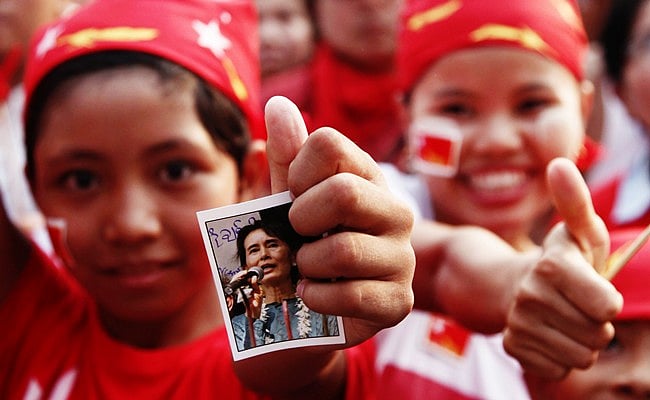
If any election was hyped up to supposedly deliver something that it simply could not, this was it. But then the Burmese elections were not usual; this was not a vote on a specific policy or a vote to choose a new government, but more an explosive expression – though arguably in a cynically controlled fashion – of the popular will after nearly a quarter century of its denial.
The by-election was initially for 48 seats in Burma's 664-seat Hluttaw, the national parliament that comprises both upper and lower houses. These seats became available when their previous holders were appointed to ministerial or cabinet roles in the country's executive, forcing them to vacate their parliamentary seats as per the rules of the Burmese system. Given the small number of seats available, these by-elections never really offered the opposition a path to power. Three seats were incontestable because of the ongoing conflict in Burma's northernmost Kachin state.
Interviewed on the day after the polls, President Thein Sein's chief political adviser Ko Ko Hlaing described the elections as a 'test' preceding the 'final exam' at the 2015 general election. 'I think the NLD (National League for Democracy), especially their leader Daw Aung San Suu Kyi, has shifted their strategy from playing outside the constitutional framework to playing within the rules of the game,' Ko Ko Hliang added. 'It gives [the NLD] an official voice, and one reason for this is [its] confidence in the president.'
Indeed, in November last year the NLD ended a 20-year boycott of official politics largely because of the reforms put in place by former general and current president Thein Sein since he took office in March 2011. Regarding Thein Sein's historic meeting with Aung San Suu Kyi in August 2011, Ko Ko Hlaing said, 'Whenever [Aung San Suu Kyi] describes the President, she sees a very sincere man who is committed to reform. After they met last August, I think they could construct mutual trust and mutual understanding, which is a significant achievement for our democratisation.' That rapport has come as a surprise to many. Thein Sein was always viewed as a moderate but, as Hilary Clinton termed it, few expected him to show such 'courage'.