
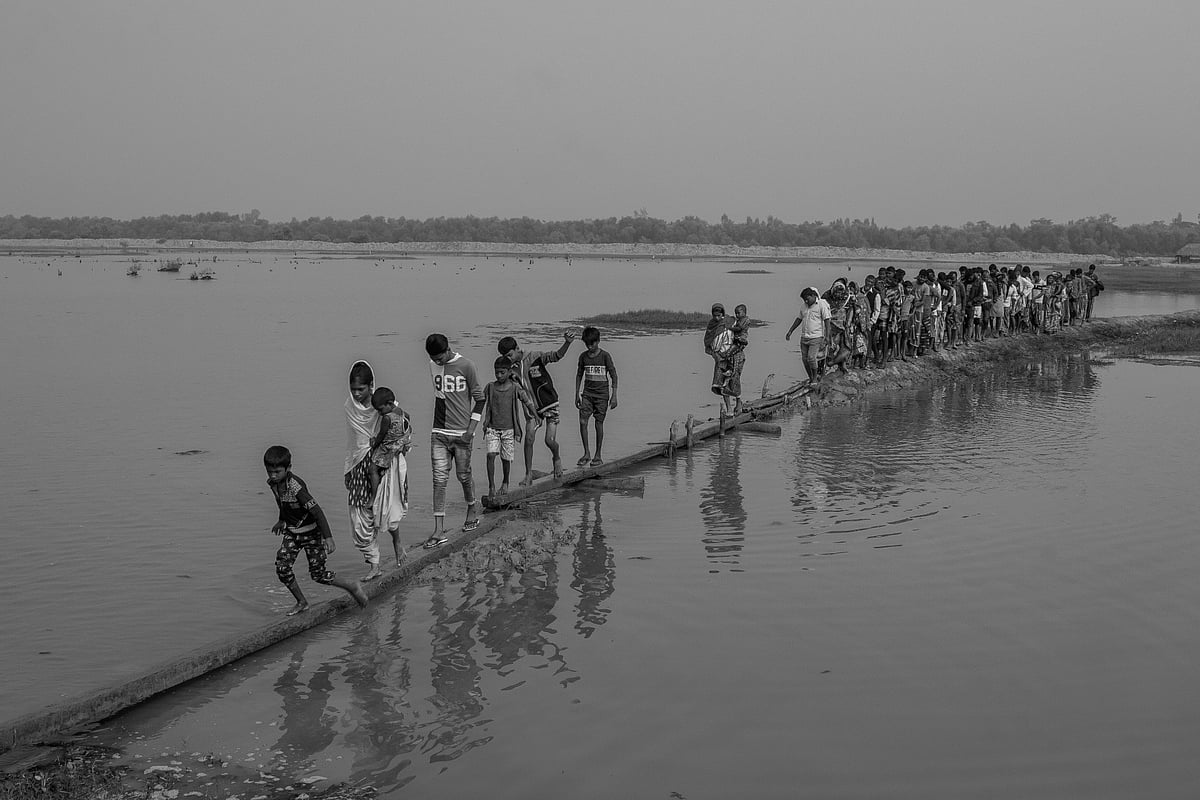
Namita Kayal was born near Satjelia, an island in the Sundarban in West Bengal, to a family who worked as farmers. Born in a Muslim para (neighbourhood), Namita says she was not allowed to continue her studies after the fourth grade, and married very early. She was just twelve years old when she moved to her in-law's house in Satjelia, a few kilometres away from her family house. Her husband frequently went into the forest with his brother to fish. Several years went by. One afternoon while she was cooking, Namita was suddenly informed about her husband's death due to a tiger attack. At the time, she was only 19 and already had two children – a son and a daughter. Her brother-in-law, who was fishing with her husband at the time, also lost his life in the attack. Namita's sister-in-law Anita now lives with her granddaughter, Sampriti Kayal, in the Sundarban.
Sampriti's parents are construction workers in Tamil Nadu, having moved there soon after cyclone Aila occurred in May 2009, as there was no work available in the region. Cyclone Aila devastated West Bengal, leading to flooding, heavy crop loss and damaged houses, with at least 191 people losing their lives and hundreds of thousands rendered homeless. Just when they were planning to move back to the Sundarban to start a small business, the region was hit by another massive storm – cyclone Amphan, in May 2020. The couple had to invest the money they had saved for their business to reconstruct their homes, which were flattened by the storm. The Kayals' story highlights the precarity of families living in the Sundarban, with increasingly frequent storms impacting their lives in unforeseen ways.
Lack of coherent planning
The Sundarban has long been prone to cyclones. It is an ecologically unique area, featuring mangroves, creeks and various types of flora and fauna, and most famously, the Royal Bengal tiger. During the Mughal Empire, the Sundarban remained relatively untouched, in part due to the persistent myth that the region was home to man-eating tigers and other wild beasts. This changed when the East India Company took over the administration of Bengal in the 1760s. Colonial settlers and hunters cleared acres of forest land, including mangroves, for cultivation, which decreased the tiger's habitat and hunting grounds. During the time of the British Raj, the clearing of trees was handed over to the zamindars. The zamindars, in turn, began to construct embankments as a buffer against natural disasters under British supervision, with migrant workers from central India hired for the actual construction. However, due to unforeseen weather conditions, the work was either postponed or completed without coherent planning. This lack of planning continues to impact the lives of the residents of the Sundarban.