
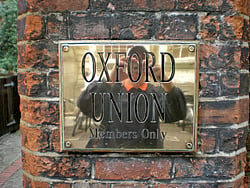
President Mahinda Rajapakse's very public failure to gain recognition in a quintessentially British elite establishment, the Oxford Union, exposes his confused strategy towards the West. The President's grandiloquent claims about his 'anti imperialist' credentials run contrary to his desire to be feted by his old colonial masters, and to be rehabilitated with them. This, we must remember, is a President who warmly embraced the Bush doctrine of the 'war on terror' and now upholds neoliberal solutions of economic development as the panacea to all of Sri Lanka's problems.
Having conquered the LTTE, the President and his nationalist allies now want to take on the Tamil diaspora overseas. If so, however, the Oxford Union debacle was a signal that the regime is far from clear on how to do so. The reality is that the regime can only make the diaspora 'irrelevant' by alleviating the plight of the Tamils displaced by war in Sri Lanka, making the reconciliation process transparent and independent, and by sitting down with the minorities in the country to discuss their political future.
While the Rajapakse regime's exclusivist Sinhala ultra-nationalist position is not lost on anyone, the Oxford incident also highlighted the shortcomings of the Tamil nationalist diaspora's campaign to internationalise the plight of the Tamils. The demonstration by diaspora Tamils holding Tiger flags indicates that it is of no consequence to them that the LTTE is now discredited amongst Lankan Tamils. Does this movement's evolution, at its heart, speak for the Tamils of Sri Lanka, or is it bent on creating a pseudo-politics for its own misguided ends? The Tamil-nationalist diaspora community is pursuing as delusional a strategy as the Rajapakse regime, banking on Western governments and institutions to offer deliverance to the Tamil people in Sri Lanka. Distancing themselves from the LTTE's armed violence, the leaders of the Tamil nationalist diaspora are also engaged in hard lobbying of governments and institutions to rehabilitate themselves. Pressurising these governments to prevail upon the Sri Lankan government is currently their sole strategy.
The diaspora seems to believe that, despite the decimation of the LTTE, it will be able to deliver self-determination and independent nationhood for the Tamils through its diplomatic efforts. It has a very short memory, forgetting its bitterness at how the international community did not come to the aid of the LTTE and the beleaguered Tamils in May 2009, at the end of the three-decade war. As recent history would tell us, the contest between the Sri Lankan State and the Tamil nationalist diaspora, in wooing the West and winning favours, has not brought dividends to either party, or to the Tamils of Sri Lanka.