
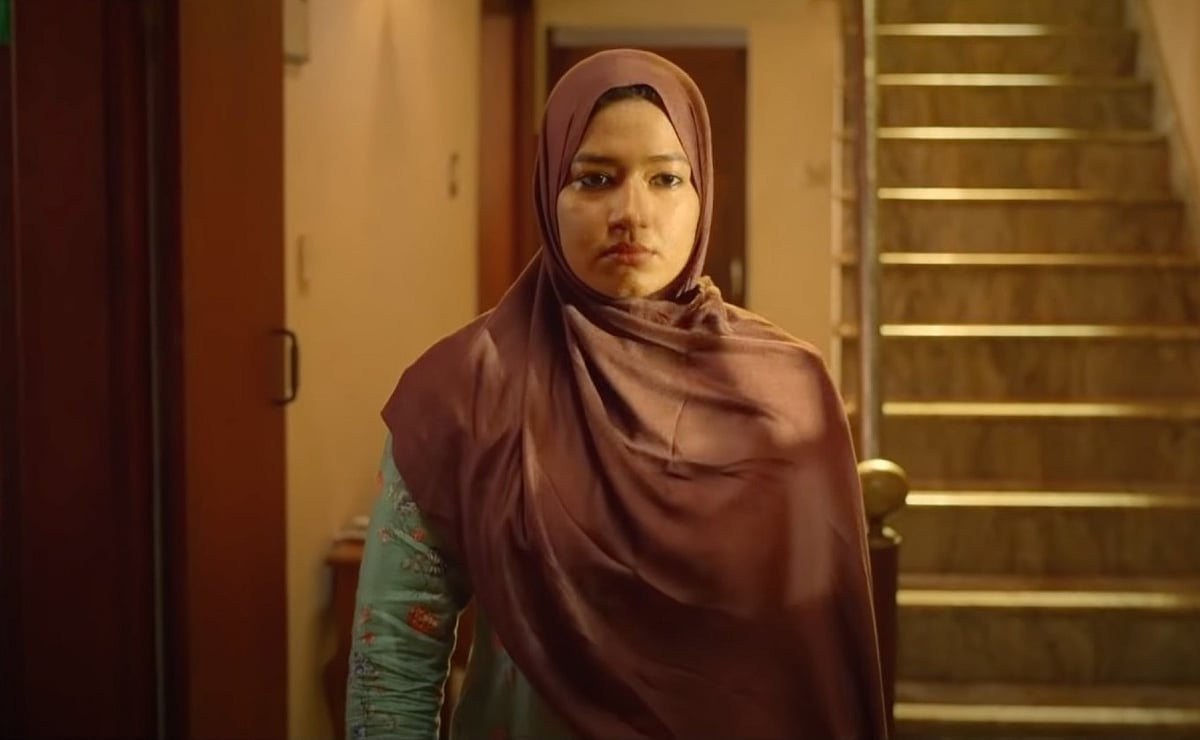
What does a movie made in a village in Kerala and released online have to do with the 'centre' in New Delhi and the Indian Muslim subject? Halal Love Story has been released at a time when the Indian state shows no signs of slowing down its anti-Dalit, anti-Muslim and militant Hindutva agenda. Among the recent examples of this is the Uttar Pradesh Prohibition of Unlawful Conversion of Religion Ordinance 2020, commonly referred to as 'love jihad law', passed by the Uttar Pradesh government under Chief Minister Ajay Mohan Bisht (the self-proclaimed monk-turned-politician 'Yogi' Adityanath), which has banned religious conversions for the purpose of marriage. This is symptomatic of persistent attempts by the Rashtriya Swayamsevak Sangh (RSS) to curb the growing representation of Dalits and Muslims in the public sphere.
The premise of Halal Love Story, set in the heart of the Malabar region, involves a group of people from a fictitious religious organisation who are trying to make a film. The characters in this film within the film, in their struggle to make art, and consequently, in their efforts to tell their stories, are constrained by the overpowering authority issued by an abstract and fictitious sankhadana (organisation). 'Jamathul Ikhwan Al-Wathan', a concocted name that makes oblique references to the Islamic group Jamaat-e-Islami, acts like a second state by exerting power over the everyday conduct of its members. A religious state, this intends to show, may use scriptural authority as a means to establish a curious hold over its adherents. It renders the characters' artistic venture, in this context of intensified censorship, a political act.
Zakariya Mohammed's movies, including his debut Sudani from Nigeria, have often shown a keen interest in the radical potential of conversational situations, as opposed to the functioning of authorities like the sankhadana or the state. His storytelling puts forward a subtle politics of resistance in the face of an omnipotent authority. Beginning with images of the 9/11 attacks and a speech in the background that calls into question the interventionist foreign policies of the United States in West Asia, Halal Love Story sets the ground for what the stakes might be when the two sankhadana members, Shaheel and Rahim Sahib, who are film enthusiasts, ponder over the possibilities of making a movie of their own. The current nationalist fervour that divides people along imaginary boundaries is instead replaced by extending transnational solidarities to oppressed Muslims elsewhere. When Abukka (Mamukoya) gets ready to act in a scene, he refuses to drink cola (which was in itself a replacement for alcohol) and accepts kattan chaya (black tea) instead. Abukka's religiosity does not end at not drinking alcohol (which is "haraam") but goes beyond it in his vehement opposition to consuming any product made in the United States due to the country's support of the Israeli occupation of Palestinian lands. The indirect reference to the Boycott, Divestment, Sanctions (BDS) movement is an instance of a global movement being played out locally through a brief moment of humour.
The story also calls to mind Abbas Kiarostami's Through the Olive Trees (1994), with respect to both content (set in provincial Iran), form (movie about making a movie), and his hyperrealist investment in the provincial or regional speaks of affiliations beyond the boundaries of the nation. This provinciality is primarily constituted by the spontaneity of everyday conversations where characters are found to converse in languageless ways through simple acts of love and care. Similarly, the moment when Siraj (Joju George) is touched by a simple act of concern (asking him if he was okay) by Thoufeeq (Sharafuddeen) are sequences that in itself become a site of resistance that overrides said norms of behaviour. These endearing moments are derived from unprecedented and awkward situations that organically develop when the pious Muslim meets the outlawed Muslim to make a movie together.