
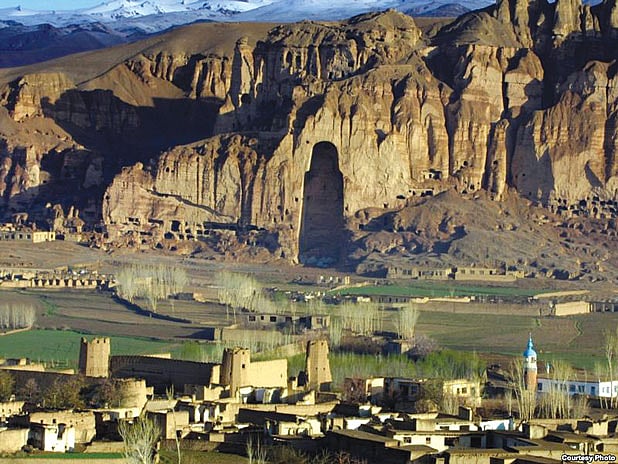
They issued me the last ticket to see the Great Buddha. Then they collected the stubs and the visitor's books and bundled them into the sacks of documents to be buried. The remaining staff of the Department for Preservation of Historical Monuments even had orders to hide things as innocuous as the books recording the impressions of the Bamiyan monuments from visitors from six continents. A potato patch will be the resting place for the archives documenting 20 years of war.
I was pleased to have a chance to wander round the site again. The rock-cut Buddhas of Bamiyan are of great cultural significance, and were once the centre of Afghanistan's mass tourist trade. In historical times, these Buddhas were targeted by zealots. Their survival (including several friezes of original paint work) through the two decades of war is amazing. But once again there is fear that zealous conquerors might try to prove their anti-idolatry credentials by destroying them.
At night in Bamiyan there was an atmosphere redolent of the Day of Judgement. The local people, the Hazaras, tried to guess how long it would be before the Taliban arrived. The sound of haunting nocturnal congregational prayers carried across the valley. The faithful feared that the Taliban would wreak revenge for 20 years of defiance and for their share of casualties in previous Hazara-Pashtun fighting. This fighting had seen some of the civil war's bitterest encounters, and the locals prayed for deliverance. The threat to the Bamiyan Buddhas is symbolic of the one hanging over much of the population of central Afghanistan.
I emptied my camera reel and headed for the security of Islamabad. My host, the head of the Department for Preservation of Historical Monuments, was busy closing up his office, loading his gelims (rough-woven Afghan rugs) and a few personal belongings into his jeep. He had done what he could to preserve central Afghanistan's share of the world's heritage. It was now time for Haji Sahib to return to his wife to share her agonising worry at the disappearance of their son, a journalism lecturer at the University of Balkh in the city of Mazar-e-Sharif, which had been overrun by the Taliban a week before. Haji Sahib's agony is shared by thousands of families, who fear that relatives in Mazar-e-Sharif may face slaughter. As the Taliban close in, the statelet of the Hazaras, built up in central Afghanistan over the past 20 years, totters on the brink of collapse.