
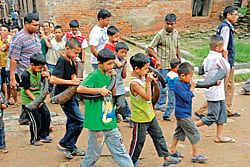
The Newar people of Bhaktapur, one of the three kingdoms of the Kathmandu Valley, have a unique musical culture that saw its heyday during the reign of the Malla kings, between the 13th and 18th centuries. Here, music-making is governed by lifecycle rituals, agricultural cycles, lunar phases and by the social hierarchy. According to a survey from the early 1970s, the town's 50,000 inhabitants divided themselves into 82 castes, and many of these play specific musical roles during town rituals. Comprising more than 70 percent of the population, the farmers of Bhaktapur are especially active as musicians and dancers. This writer's survey of Bhaktapur in 1984 counted more than 200 active music and dance groups. Today, this picture has dramatically changed.
All musical activities are part of the cult of Nasahdyah, the lord of music and dance, who receives blood sacrifice and musical offerings during musicians' apprenticeship. The destructive aspect of the music god is called haimadyah; musical mistakes are ascribed to him. Musical invocations addressed to both gods are called dyahlhaygu ('calling the god'), and serve as a direct link between the human world and the realm of the gods. Newars perceive their towns as permeated and protected by divine influences. During processions, the playing of musical invocations actualises divine energies residing in countless temples and shrines. Specific stones at street crossings, divine flight lanes demarcated by holes in brick walls, holy trees, rivers and religious monuments along the way induce musicians to play specific drumming patterns. The entire townscape is charged with meaning, becoming a musical score that tells musicians when and where to play what. The playing of such invocations can be compared with the dialling of a complex telephone number: If you dial/play correctly, a connection with the source of inspiration is established.
Urban space throughout Southasia is depicted, in an idealised form, as a mandala by traditional painters. In the case of Bhaktapur, this is diamond-shaped, with the main gods and goddesses occupying several areas. The area inside the boundaries of the mandala is protected by gods sanctifying the living space of humans against the chaos outside the town limits. There, evil spirits lurk and potential danger awaits the traveller. Whenever musicians play processional music inside the town, addressing the gods on the way with dyahlhaygu invocations, the divine order is actualised. The music makes sense in its relation to the locality and to the community.
Quiet Gunla?
Bhaktapur lies in a contact zone of Hinduism and Buddhism, both of which are heavily influenced by Tantric practices. During the processional month of alms giving and receiving (Gunla), Buddhist groups of all Newar settlements display significant activity, in order to accumulate positive karma for their afterlife. In Bhaktapur, two genres of Buddhist processional music can be distinguished: that of the Sakya artisans and that of the Saymi oilpressers. Despite both being Buddhist, these groups occupy different ranks in the social hierarchy. The Sakya intermarry with Bajracharya ritual specialists, and are considered above Newar farmers; Saymi oilpressers, on the other hand, are seen as below farmers. They also differ in their use of musical instruments, repertoire and daily processional routes that establish their respective mandala in the course of the month of Gunla.