
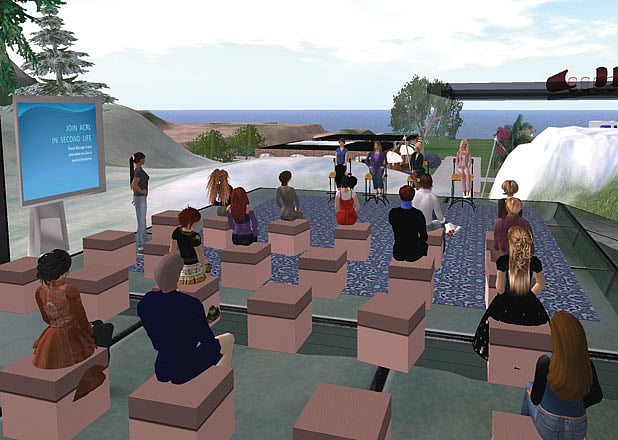
On online social networks like Facebook, it has become commonplace to refer to our online personas as extensions of our offline selves; for instance, in Second Life – a virtual world complete with currency, marriages, land ownership, national embassies and much else – users' personas are called 'avatars'. But what does it mean to extend one's identity into the internet? Does the persona translate with ease across these different extensions and performances of the self? Where and how does one draw a line between the 'virtual' and the 'real' self? What does it mean to 'inhabit' or 'dwell in' an online space?
We increasingly encounter traumatic experiences online: suicide notes on Facebook, the sharing of personal sexual videos, increasing cases of impersonation and character theft. While all of these pose new problems for our thinking on the future of online ethics, there is a slightly more mundane phenomenon that seems to hold the key to unravelling many of these larger questions: the gap that people sometimes experience between meeting someone online and encountering the same person offline. This often takes place in the realm of romantic encounters but is certainly not limited to them, and the idea that people aren't as they appear to be online often provokes deep disappointment, at times even a sense of betrayal or having been cheated. It feels as though, on the internet, the person had been impersonating someone else all along. But if it is impersonation, then the question is who exactly was the person impersonating?
The word 'persona' comes to us via Latin – Per Soane referred either to an actor's mask or, more literally, to that through which the sound of an actor's voice was heard. 'Personae' is also the root word for 'person' and 'personality'. Balinese dancers, as well as South Indian Kuchipudi dancers, claim that for a performance to be really effective, the face inside the mask must become indistinguishable from the mask itself, and that the best dancers are those who are able to take their inner emotions and project them through the mask. So, when we return to the very basic idea of personhood, we immediately face the dilemma of how and where to draw a boundary between a person and his or her persona. The philosopher Giles Deleuze once said of his collaboration with the psychologist and philosopher Guattari, "I used to work alone, and even that was too many people, and then came Guatarri." Reworking that quote for our times, one could say, "I used to be too many people, and then came the internet."
The ideal subject of psychiatry – assumed to be a healthy, self-contained person who knows where his or her self ends and other selves begin – may be one of the sustaining myths of modern subjectivity. Modern medicine and psychiatry has always seen the possibility of multiple selves within the same subject in pathological terms. But what if we replaced the language of 'multiple selves' with 'online personas'? Would we have to invent a new pathology of multiple persona disorders?