
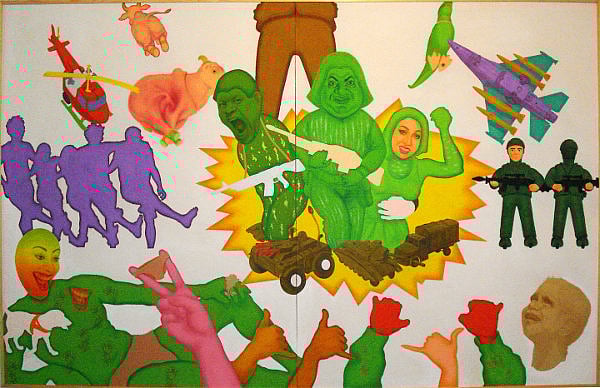
Samuel P. Huntington's book The Soldier and the State popularly defined military professionalism to include subservience of the armed forces to civilian authorities. Subsequent works on civil-military relations in Latin America, Southasia and Southeast Asia – by Alfred Stepan, Amos Perlmutter, Morris Janowitz, Harold D Lasswell and others – widened the definition of military professionalism. One of the conclusions of these works was that in places where political and civil societies are weak, the militaries' role could not be confined to defence and fighting wars. Being modern and developed, many militaries in these regions would also be engaged in affairs of the state. Nevertheless, civilian control over militaries continues to be widely considered a marker of 'good' civil-military relations and of military professionalism. It is, for example, an important variable for being recognised as professional military by NATO.
The emphasis on viewing civil-military relations purely from an administrative perspective, however, is problematic. Simply asking who is 'boss' is not enough. What about countries where militaries engage in oppression at the behest of its political leadership? Even if the military is under civilian control, it can still have great influence in society and close links with a largely militaristic political class. It is therefore important to examine Southasia's militaries' internal engagements and how certain groups are marginalised by the state with the support of the army. The increasing militarisation of societies throughout Southasia has turned the civil-military balance into a more complex matter.
When conducting fieldwork across different Southasian states on civil-military relations, people sometimes reacted strongly to my identity as a Pakistani. Experts, policymakers and even ordinary people in India, Bangladesh and Sri Lanka were often quick to remind me that their countries were not like Pakistan. At times, I would get long lectures on where Pakistan went wrong – even in Bangladesh, where the military has inherited Pakistan's pattern and has not remained subservient to civilian rule. What such comments overlooked is that the civil-military balance is shifting towards the latter across Southasia – not just in Pakistan. During my research, I did not come across a single military that did not think it was superior to the political leadership. This sense of superiority or arrogance of the armed forces, largely stemming from their control over weapons, is another issue that most Southasian states and societies are unaware of. The more professional and technologically evolved a military is, the more difficult it becomes for the political leadership to handle it.
India
"All Indian army officers are asked [by ordinary people] to take over but do not do so due to their respect for professionalism," said Indian Army Lieutenant General (retd) B N Sharma. Many would dismiss this as an individual statement but it is reflective of a society where the place of the military is being gently re-arranged. Even though the modern Indian military has remained separate from and outside the structures of politics in India, due to the state's particular history and set-up, it has changed significantly since Nehru's time. The military has not remained apolitical and tries, often successfully, to influence national security decision-making and to improve its image and increase its role where possible.