
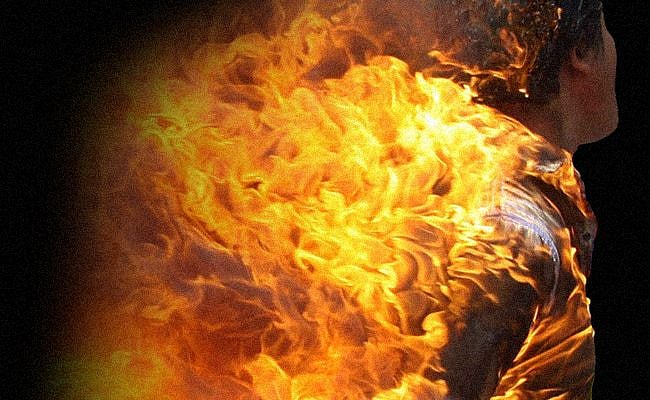
The string of self-immolations inside Tibet – started in 2009 by a Kirti Monastery monk named Tapey and which most recently claimed two monks in Barkham County on 30 March – shows no sign of letting up. On the contrary, despite the Chinese government unleashing one of its harshest crackdown to date, despite state paranoia and military repression even more acute than during the clampdown on the 2008 uprising, and despite the abysmal response from the international community, an incredible wind seems to be fanning across occupied Tibet – a wind at once frightening, and pregnant with hope.
While analysts scramble to offer logical explanations for these horrific protests, many of them regurgitate the obvious and overlook the vital. If anything, the self-immolations suggest three undeniable truths. One: the Tibetan freedom struggle's patience has snapped. Two: these protests embody the movement's radicalisation, which was a long time coming. And three: Tibetans inside Tibet, and not the exile leadership or the diaspora, drive the narrative of the struggle. As with the ground on which they fell, the 33 self-immolators (32 of them in the last year alone), embers falling from their bodies like rosary beads, have left the landscape of the Tibetan freedom movement irreparably scorched and irredeemably altered.
One recurring point of reference has been the Vietnamese monk Thich Quang Duc who, photographed as he burned in meditation pose in Saigon in 1963, is immortalised in what remains the most iconic image of self-immolation as protest. The Vietnamese self-immolator was protesting against the religious persecution of the country's Buddhist population by the Roman Catholic administration ruling Vietnam at the time. Thich Quang Duc and those Vietnamese who later followed his example were all from the monastic community. To a great extent the same is also true of Tibetan self-immolators, the majority of whom have been monks or nuns. The parallel, however, stops there.
Beyond that, ascribing any exaggerated religious impulse to the self-immolations is unwarranted. Doing so amounts to fabrication, and is a disservice to those who have sacrificed their lives. While some such distortions are simply ill articulated, others are downright manipulative. A case in point is an article titled 'Man on Fire' (Himal Southasian, 10 February 2012) written by Bhuchung K Tsering of the International Campaign for Tibet (ICT), who termed the self-immolations a precursor to a 'Tibetan Buddhist Liberation Theology'.