
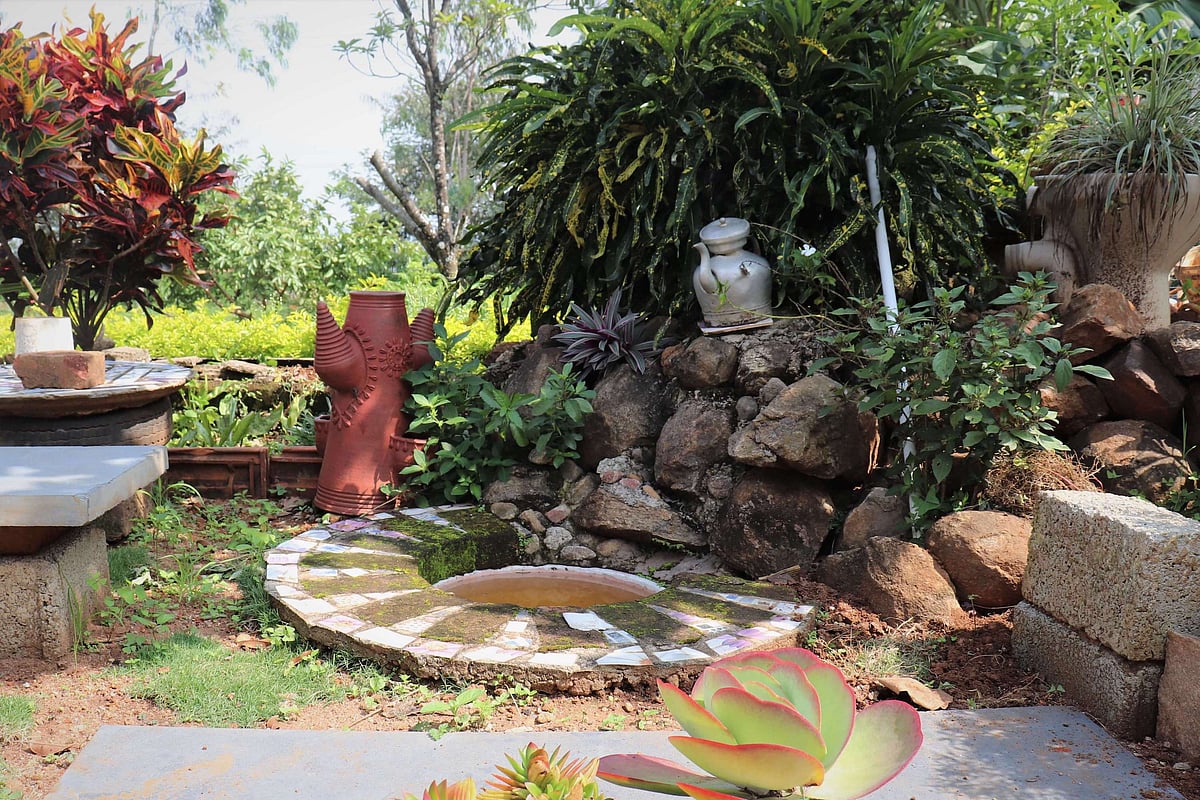
"Anything will grow in this place. That's what I've noticed," Dawa Dhondup said as he sat in front of his green-and-white-painted one-storey house on a sunny morning last September. "In my garden, you'll find papaya, orange, custard apple, guava, jackfruit, avocado …" He continued reciting the list in his head. "Altogether, I have about 12 or 14 varieties of fruit trees." Some, like the banana tree, were planted many years ago, while others, like the waist-high pomegranate bush and a grafted mango tree, he added recently. In a few years, they will have grown tall and will overshadow the vegetable and flower beds that Dhondup has also laid out in his garden. "Then it'll be nice to walk underneath," he imagined.
Dhondup and his neighbours have cultivated an astounding variety of fruits, vegetables, flowers and herbs in their home gardens in Dhondenling, a Tibetan refugee settlement in rural southern Karnataka, at the foot of the Biligiriranga Hills. Dhondenling is surrounded by a dense shola forest, a part of which was carved out to build the settlement. Established in 1974, Dhondenling is approaching its 50th anniversary, to be marked with a multi-day celebration in 2024. It will also mark 65 years after the 14th Dalai Lama and thousands of his followers fled Tibet, in 1959. Since its foundation, the settlement – called "Mini Swiss" by its inhabitants because of its scenic location – has undergone remarkable development, reflected in its roads, monasteries, health and educational facilities, and also in the way people have laid out their homes and gardens.
While not every garden is as diverse as Dhondup's, there is hardly a yard that does not have at least a couple of fruit trees, or a house without a few pots of marigolds or snake plants, or a gate not framed by white or bright pink bougainvillea. The gardens of Dhondenling tell a story of change – of arrival and of making a place one's own, of negotiating adaptation and preservation, of learning and exchange, of shifting livelihoods and resilience. Over the years, the settlement's gardeners have retained the hope of one day returning to pha-yul – the Tibetan homeland – but have accepted that Dhondenling will be home for the time being. As the years in exile have gone by, people have planted more and more trees and other perennial plants – some from single fruit stones, others from seeds or saplings – as they have literally and figuratively put down roots.
The early years