
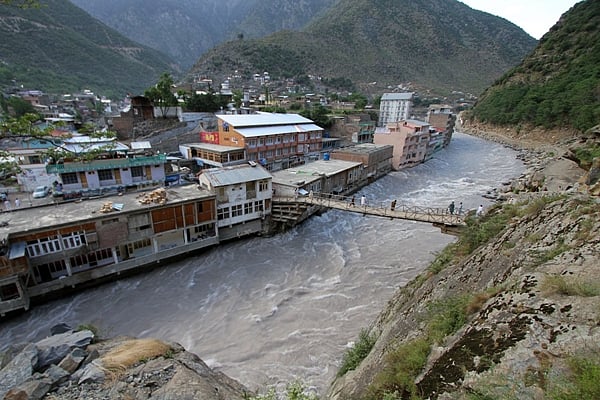
After years of war between militants and the Pakistani Army, Swat is now considered safe to travel to, and is open for domestic tourism. To explore the culture of Swat, I embarked on a short journey this summer, taking a bus from Rawalpindi to Mingora, the main town in Swat. The journey took five hours, with several security checkpoints along the way.
At Mingora I transferred to a local van to get to the next town, Bahrain. The road was severely damaged by the flood last year, making the ride bumpy and dusty. I reached Bahrain late at night, and it had started to rain. Tired and exhausted, I was greeted by my host Zubair Torwali, a man in his late 30s with thick, combed hair, a well-trimmed moustache, wearing a traditional shalwar kameez.
Before falling into bed I had a cup of tea with Zubair and his friends in the hotel lobby. He would talk to me in Urdu while the rest of them spoke a language I was trying hard to understand. I can understand Pashto. This wasn't Pashto at all. I curiously asked which dialect of Pashto they were speaking. Zubair smiled, paused, and with a confident gesture replied, "It wasn't Pashto. We speak Torwali."
Like many Pakistanis my assumption was that in Khyber Pakhtunkhwa (KPK) they speak only Pashto. In school I was taught that the national language of Pakistan is Urdu, and that Pakistan has four provinces: Sindh, Balochistan, Punjab and the North West Frontier Province (now KPK) where Sindhi, Balochi, Punjabi and Pashto are spoken respectively.