
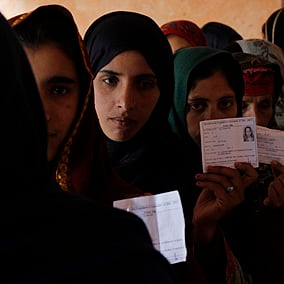
Jammu & Kashmir's 2014 State Assembly elections witnessed a significant voter turnout. As per the Election Commission of India, the total turnout of the five-phase Assembly elections was recorded to be 65 percent, the highest in the last 25 years. Though voter participation has risen in recent years, it is yet to reach the 75 percent recorded in 1987, when a deeply flawed electoral process precipitated the onset of the armed separatist insurgency.
Elections in Kashmir have long held deep symbolic importance. Mainstream parties campaign on developmental issues and good governance, but their efforts are often interpreted as reinforcing the virtues of Indian democracy and the place of J & K within the Union. For this reason, separatist groups have consistently boycotted the electoral process and urged voters within the Valley to do the same. At recent Assembly elections the trend changed, as did the public statements of separatist leaders.
Hard-line separatist leader Syed Ali Shah Geelani has, for many years now, been intransigent in his opposition to participating in the electoral process. This time around, however, Geelani's boycott calls were muted, and limited to statements urging shutdowns in poll-bound areas.
Geelani's greater flexibility reflected that of other, more moderate, separatist leaders, including Mirwaiz Umar Farooq, who says participation in elections is a 'non issue' for him, and that if elections are a means to achieve better governance then he has no problems with it.