
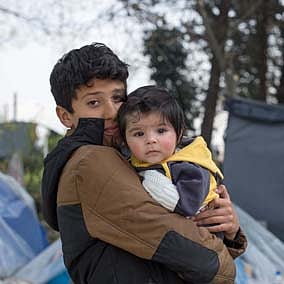
For the majority of the over 1.2 million migrants that travelled overland from West Asia and Southasia to Europe in 2015 and early 2016, Greece was the front door to Europe. In early 2016, this door was slammed shut for many and distinctions are being made throughout Europe between genuine refugees and "economic migrants" – individuals traveling from countries like Pakistan and Afghanistan in search of a better life, which governments in Europe do not consider tumultuous enough to warrant relocation.
Sitting on a makeshift bench made out of old wooden crates a few metres away from an heap of orange lifejackets on Lesvos Island, 28-year-old Pakistani Ali Raza and his friends look out to the horizon, where just several weeks before they had sailed over on a small dinghy. Less than 20 kilometres away, Turkey is still clearly visible. The faces of these young men are without expression, but they appear to be looking many thousands of miles over the water in front of them.
Lesvos Island is a hotspot for tourists. Its soft winding hills are covered with verdant olive orchards, natural hot springs, and small inns – the sky perfectly blue with white clouds hanging close to the ground. For the refugees on the island, this island of paradise has become a purgatory. They are stuck on the welcome mat of a shut door, unsure what will become of them, and for many, there is no home to return to.
In the months of March and April 2016, I reported from Germany, Greece, and the surrounding Balkan states to follow the path that refugees took as they made their journey to Europe. This article provides a window into the experiences of those who have travelled along this 'Balkan route' – Greece, Macedonia, Serbia, Hungry, Croatia, Slovenia, Austria and Germany; the European leg of their journey begins in Greece, and eventually makes it to Berlin, the final destination.