
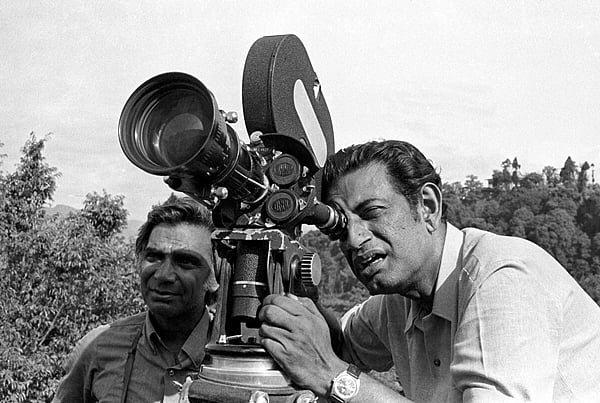
The renowned lyricist and Hindi screen-playwright Javed Akhtar, when delivering the first Satyajit Ray Memorial Lecture in 2009, explicated two reasons why he felt Ray's films are still relevant today: firstly, his strong emphasis on the dignity of reel characters; secondly, his understated style. These comments stayed with me for a long time after I had watched a recording of Akhtar's lecture. I could not bring myself to agree with him, and the more I thought about it, the stronger my disagreement grew.
In order to be fair to the argument, it is imperative to introduce the rationale that Akhtar presented. "When I think of [Ray], when I think of his films, certain words come to my mind. That is how I describe his work, his art to myself. The word is dignity, the word is understatement, compassion" said Akhtar. He used the example of Ray's masterpiece Pather Panchali (A Song of the Little Road, 1955), a scene in which the child protagonist Apu throws a necklace into a pond. His late sister Durga had stolen this necklace from their neighbours. Apu, through this act, attempts to salvage some dignity for Durga. Akhtar's other example was from Jana Aranya (The Middleman, 1975). Kauna takes the pseudonym Juthika as part of her sex-worker identity and insists on getting paid for her services (upon being hired inadvertently by her brother's friend, the protagonist), thereby keeping her dignity intact in a rapacious patriarchal Kolkata.
Akhtar opines that this dignity is missing in the characters of today's films. Since films, commercial or parallel, are essentially mirror images of the society in which they are made, this dignity is by extrapolation missing in today's society. Why is that so? He points out at least two reasons.
The first is a blind emulation by a several thousand year-old Southasian civilisation of the relatively younger society of the United States, "a country that may have everything but obviously does not have history or tradition". Given a normal propensity to deny the importance of what one lacks, US society has developed "a casual attitude, an aggressive attitude" which, in turn, is mimicked by Southasian communities.