
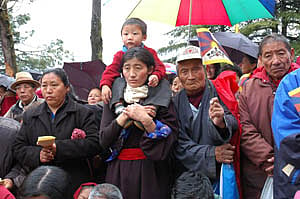
On a cold and wet Saturday morning a few weeks ago, several thousand of us exile Tibetans gathered once again with our leader, the Dalai Lama, in the courtyard of the main temple in Dharamsala to commemorate the anniversary of the Lhasa Uprising of 10 March 1959 – the event that triggered our exodus to India, and sealed China's occupation of our homeland. As with every 10 March commemoration, speeches were made and songs were sung to remember those who gave their lives in pursuit of Tibet's freedom.
In his statement this year, the Dalai Lama once again reiterated his commitment to the Middle Way approach – his proposal to resolve the Tibet issue by making the key concession of giving up demands for independence, in return for a genuinely autonomous Tibet within the People's Republic of China. And once again, the unresolved incongruities of the Tibetan situation manifested themselves. As the Dalai Lama spoke, above him stretched an enormous Tibetan national flag, still banned in Tibet for being a symbol of nationalist aspirations. Those gathered also sang the Tibetan national anthem, another expression of Tibet's separate identity proscribed by Beijing. And during the traditional march to the town centre in Lower Dharamsala that followed the speeches, the crowd once again raised slogans calling for a free Tibet, and demanding that China leave the plateau.
The Tibet movement has suffered this split-personality syndrome ever since the Middle Way approach was first broached, more than two decades ago. The Tibetan community's complete devotion to the Dalai Lama as our spiritual and political leader has meant that, for the most part, we have accepted his proposal without any question. Indeed, until recently, any expression of doubt on this matter was immediately denounced within the community as being a personal attack on the Dalai Lama himself. But while on the surface there has been a unified show of support and commitment to the Middle Way approach, deep down many Tibetans have suffered a disquieting crisis of confusion and conflicting loyalties (See Himal December 2006, "Roadblock on the Middle Path").
In exile, we were brought up to believe that our raison d'etre was to fight for Tibet's independence. From the time we were children, the word rangzen – independence – was relentlessly hammered into us. To be suddenly told that rangzen was no longer our goal was almost impossible to comprehend; and indeed, during the 1980s, in the early days of the Middle Way approach, we went about our lives as if nothing had fundamentally changed in our struggle. But as time passed, we could no longer pretend that this contradiction between our loyalty to the Dalai Lama and our instinctive belief in Tibet's independence did not exist. Our confusion became more difficult to ignore, and we were stricken by a sense of helplessness and frustration. As a result, some vital force was sucked out of our movement, and it began to founder. Even our most ardent supporters began to wonder what it was that we were fighting for, and the once-impressive international support-group network that we had so painstakingly built up began to unravel for want of a clearly defined cause.