
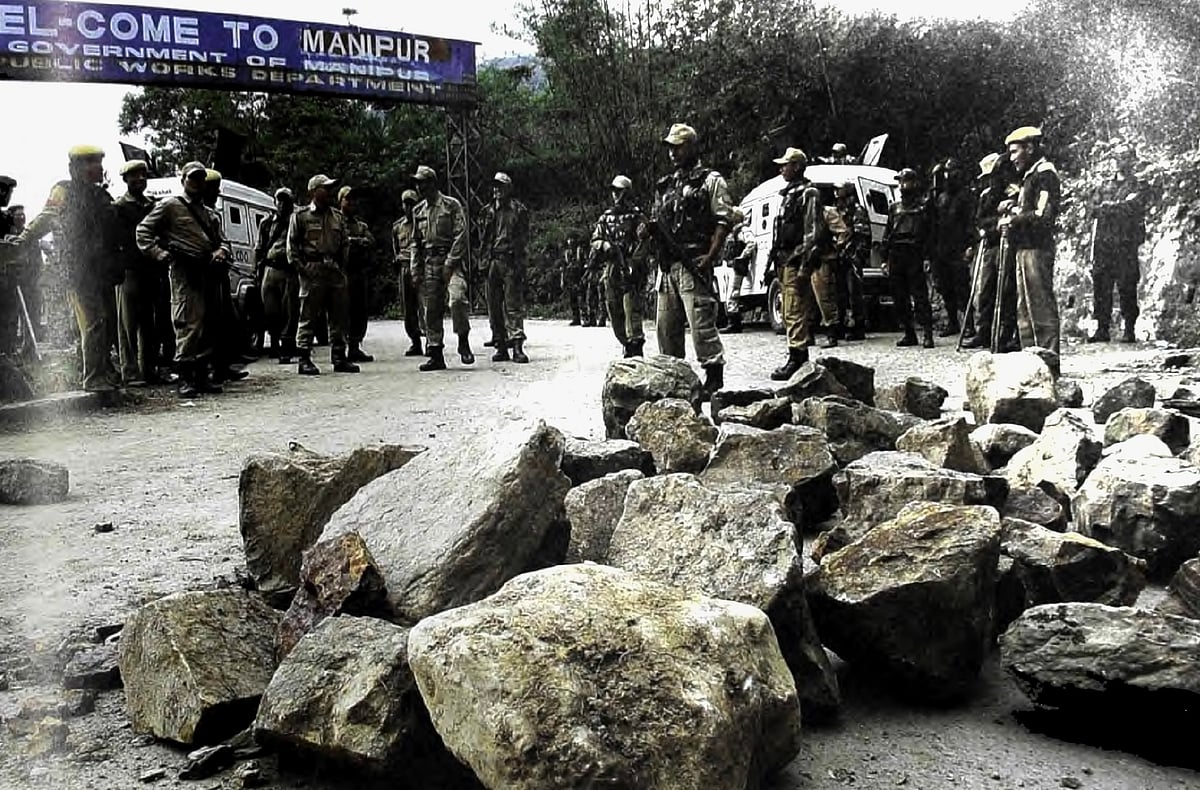
A week before two Naga boys – Chakho and Loshou – were killed by the paramilitary Manipur Police Commandos at Mao Gate, on the Manipur-Nagaland border; a week before 4000 people from Senapati District in Manipur were displaced from their homes to languish in makeshift camps, hospitals and homes of relatives around Nagaland; a week before Thuingaleng Muivah, the longtime Naga militant leader, attempted to visit his home village of Somdal, in Manipur; a week before 6 May 2010, when those two deaths started the recent flood of bottled-up sentiment in the Northeast – the signs of the Ibobi Singh-led Manipur government setting itself against a section of its own people were there for all to see.
Since 12 April, the All Naga Students' Association of Manipur (ANSAM), along with a few other groups, had imposed an economic blockade on Manipur, in support of their demands regarding the Autonomous District Council (ADC) elections in the hill areas of Manipur (see accompanying article, 'Peoples under siege'). But from 5 pm on 2 May, after the Imphal government banned Muivah from entering the state, the government imposed Section 144, legislation prohibiting all gatherings in the hill districts of Manipur (where Manipur's Naga population is concentrated), and deployed extra security forces. It then went on to block the Mao Gate road – National Highway 39, the first point of entry from Nagaland into Manipur, prohibiting all vehicles from Nagaland and beyond from entering Manipur. Backed by armoured cars, advanced weaponry and bulletproof armour, paramilitary troops set up bunkers surrounding the Mao Gate area, rolled in boulders and locked down the road completely. In the event, Muivah stayed out.
Manipur is already conflict-riddled. But thanks to Ibobi Singh's government, today Manipur stands closer to being called a communal state, where a Hindu government rules the valley and the 'uncivilised' people inhabit the many hill tracts. When on 20 May, in the midst of the recent surge in unrest, the Congress party MP from Manipur, Thokchom Meinya, appeared on a nationally broadcast news show during prime time to declare that Manipur is a Hindu state, it was another reminder of how his Chief Minister, Ibobi Singh, has invented himself as the Narendra Modi of the Northeast. While Hindutva ideology has defined Modi's politics, Ibobi Singh has managed to blend in permutations of ethnic politics, religion and colonial stereotypes of hill versus valley (where the latter is considered the obvious seat of power) to govern present-day Manipur. The consequences have been disastrous, and they will likely get worse.
Manipur is one of the most multi-ethnic states in India, and it requires a confident government to talk to all ethnic groups amidst longstanding demands, varying topography, armed groups or religious beliefs. The state is a miniature of India at large, with numerous identities and as many if not more demands. Unfortunately, the stories of persecution and discrimination too remain the same, centring on allegations of anti-hill racism and discrimination by the ethnic Meitei, the dominant valley inhabitants. The basic grievance revolves around how the Imphal Valley and the Meitei community have dominated the politics and history of the state for decades, if not centuries.