
Muhammed Afzal P (MAP): Let's come to your new film Red Ant Dream, the third in your trilogy of films on Indian democracy. In this film you show three places and three kinds of struggle. One is the armed struggle in Bastar; the second is Niyamgiri, a sort of peaceful Gandhian socialist movement; the last is in Punjab, which is like a left liberal struggle. How do you bring these three struggles together, and connect them with the revolutionary figure of Bhagat Singh?
Sanjay Kak (SK): I am glad that Red Ant Dream is being discussed for its form as well. It is often only the content of the film that comes up for discussion! The core of the film is in Bastar, in the armed struggle. I wanted it that way because it was a response to something that has been bothering me: the pretension people have that what is happening in Bastar is an aberration, and that the Maoists have gone to the forest and driven the adivasis there into some sort of frenzy to kill people. What I wanted to emphasise is that where the Maoists find themselves in Bastar comes from a long history. This is not a film that traces that history for you. It merely suggests that there is a history. There was Bhagat Singh, there were the Naxals in Punjab and so on – I'm not saying that there is a linear progression. Let's admit that this tendency of armed resistance has always existed, but it is socialist as well. It is not merely an armed resistance but an armed struggle, the backbone of which comes from a kind of Marxist reading of the society, however broad that might be. Bringing out this was the desire behind the film.
Since I had been travelling in Odisha, I was in touch with the people who are fighting against the corporates in Niyamgiri. I knew of their struggles and I had met Lingaraj Azad (well-known activist of the Dongria Kondh community) many times. I was very impressed with him, but at the same time disappointed that he never appears in the outside world other than when giving speeches or shouting slogans. I remember asking him once whether he sees himself as a revolutionary. His reply was that "Of course, because I am willing to put my life on the line. I might not be carrying a weapon, but I am a revolutionary." I found this interesting and thought 'why should I not bring what is happening in Odisha to the film to suggest that they are revolutionaries', not just because they are putting their lives on the line, but because they also have some alternative vision of the world. They are not reformists. They are not saying 'let's change the world just a bit'. What they are saying is, 'we don't want this system'. I see that as revolutionary. So that is how the Odisha thing started coming in. In Bastar, we see people taking to arms, and in Niyamgiri, we see that people have not yet taken to arms. But we never know what will happen in the future. The film is poised at that point.
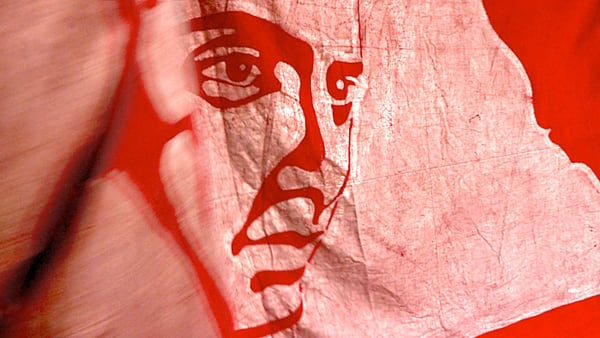
The part on Punjab came in a more roundabout way. I had read the poetry of Avtar Singh Pash, and at least in North India he was considered one of the most articulate voices of his period. I wanted to bring some of his poems in the film. So I made a trip to Punjab to talk to various people about Pash. I met a professor of English in Amritsar and asked him what remains of the Naxalite movement in Punjab. "Poetry, and culture," he said after a pause. I was struck by this answer. So what is this culture? When I started my exploration, it was only then that I realised the coincidence that both Pash's death anniversary and Bhagat Singh's death anniversary are on the same day. So I decided to go there in March to see the death anniversary celebration there. I went with my crew and started filming. I witnessed the massive mobilisations that they have been able to achieve around the image of Bhagat Singh. It was also done in a very thoughtful way – they never allow people to forget that Bhagat Singh was a socialist, that he was a communist. They were not making the mistake of portraying Bhagat Singh as just a patriot, the way BJP or Congress would want to.