
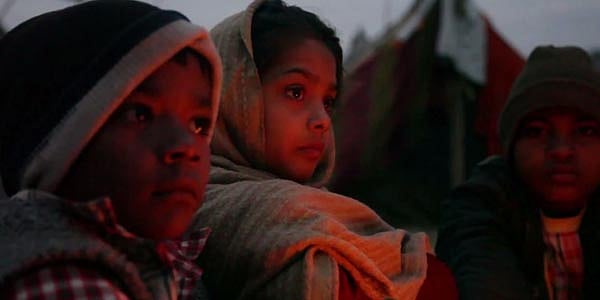
A house with beautiful doors appears as a recurrent motif in the documentary Muzaffarnagar Baaqi Hai (Muzaffarnagar Eventually…) directed by Nakul Singh Sawhney. Early in the film, an old woman in a relief camp speaks of this house, destroyed in the riots. "My home is a mansion with 52 doorways," she says. "They broke all the doorways, all the beds, set the arches on fire… Alas, my doors," she laments. Despite other, more valuable losses, like that of her daughters' jewellery, it is the doors that she weeps for. We see the remains of her home when Sawhney visits her village. A few arches still stand, framing rubble from shattered walls, the debris left from the near-complete destruction of the haveli. In the next sequence, we see the family watching this footage in the relief camp where they now live, squeezed under tarpaulin sheets. One of the men asks a child gazing at the images, "Whose home is this?" "Ours", the boy replies, his eyes glued to the laptop screen.
Muzaffarnagar Baaqi Hai is a film made of hard-hitting facts, but moments of reflection like these anchor the narrative, putting the events in terms of human cost – in the many shades of meaning that expressions cover. In its scope and meticulous detail, the film is an important document of Muzaffarnagar's descent into communal vitiation. Through testimonies and sourced footage, it traces the murky path beaten to the national polls on the back of the hardening of the communal equations by different political parties. Of these, the largest gains went to the Bharatiya Janata Party (BJP). The sprawling and densely populated state of Uttar Pradesh (UP) sends 80 members to India's lower house of Parliament, the Lok Sabha. In the 2009 general elections, the BJP managed to win only 10 of these seats. In the 2014 polls, however, this shot up to 71. In the years to come, Muzaffarnagar Baaqi Hai may well become the film we consider as the document that captured this phase of expansion of both the BJP and its project to transform India.
Sawhney, a graduate of the Film and Television Institute of India, has worked on documenting a range of social struggles in the past. His 2012 documentary, Izzatnagari ki Asabhya Betiyan (Immoral Daughters), is an incisive look at khap panchayats (caste-based councils) in Haryana, and at the women who are resisting their diktats. He also produced videos on the Maruti Suzuki workers struggle in Manesar. Sawhney travelled to Muzaffarnagar in September 2013, soon after the area broke into widespread violence. He ended up returning repeatedly, shooting over the months leading up to the general elections in April 2014. The 136-minute film covers this crucial period. It is no coincidence that it begins with the words of revolutionary Hindi poet Gorakh Pandey, "Iss baar danga bohot bada tha/ khoob hui thee khoon ki baarish/ agle saal acchi hogi fasal matdaan ki… This year the riot was very big/ There were heavy rains of blood/ Next year the harvest of votes will be abundant."
Bookended by these lines, the film moves through three parts that broadly look at the riots, the equations between Jats, Muslims and Dalits, and the pockets of resistance to the cynical game of communal polarisation. The sugarcane fields and the sugar factories form another motif in the film. The lucrative cash crop created relative prosperity in the region, and tied communities together in links of mutual dependence. These are shown to be unravelling after the riots. The severe north-Indian winter is also a character in this film – seeping into the fragile tents of the refugee camps, framing the slow-moving bullock carts laden with sugarcane, and both obscuring and revealing the complex landscape of the region.