
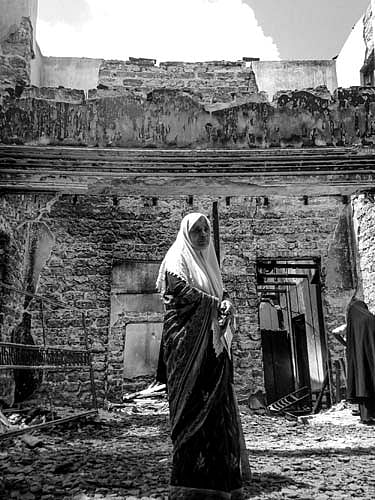
Fear eclipses the minorities. For the war-torn Tamils in the north and east it is the fear of social anarchy and everyday violence. It is fear of violence within the home, by the neighbours, on the roadside and of the police and the military. For Muslims living around the country, it is the fear of insults, of mob attacks and a state turned against them.
How does one explain the contradiction between the widespread military presence meant for repressive order, and the social anarchy taking hold of a war-torn society? The government claims the massive presence of security forces in the country is there to ensure the order necessary for development and economic prosperity, but then, how are Muslim businesses targeted with impunity?
The military and the police are the arms of the state that deploy legitimised violence, including lethal force. Indeed, historically some political theorists have defined the state as the entity that has a monopoly on legitimised violence. In this context, looking at the use of lethal force and violence by the state is instructive. In the war-ravaged districts of the north and east, the overbearing and intimidating presence of the military is ubiquitous, but hardly a bullet has been fired since the end of the civil war in May 2009. However, in many instances, as soon as there is protest on an issue, whether in the university or on the streets, the military steps in to shut it down. Until recently, it was extreme Sinhala Buddhist organisations that were targeting mosques and Muslim-owned shops as part of an anti-Muslim campaign. However, during the episode of organised violence in June 2014 against Muslims in Aluthgama, where a pogrom led to the killing of three Muslims and a Tamil, people in the affected area stated that security forces allowed the attacks to take place.
In the post-war years, the state has used lethal force to suppress protests. Most of those victims have been from the subaltern classes and incidentally belonging to the Sinhala community. A free trade zone worker was shot and killed when militant protests defeated a problematic pension bill in Katunayake in 2011. A fisherman was shot and killed during massive protests in 2012 that shut down coastal areas as the government increased the price of kerosene by 50 percent over night. Also that year, two prison rebellions, one against horrendous conditions in Welikada Prison in Colombo and the other in Vavuniya Prison, resulted in prisoners being injured and killed. And in 2013, villagers in Weliweriya protesting the contamination of local water by effluence from a factory were killed as the security forces crushed their street-blocking demonstration.